

Finding genuinely small terrarium plants is harder than it sounds.
Plenty of plants start tiny, but not all of them stay that way. I’ve been caught more than once by a “cute little fern” that turned into an absolute monster a few months later.
This list is here to save you from that mistake.
Every plant below is well-suited to terrarium life and maintains a small leaf size as they grow. We’ve got everything from miniature ferns to compact vines and slow-growing foliage that won’t overwhelm a tiny container.
- The Best Small Plants for Terrariums
- 1 | Pilea glauca
- 2 | Fluffy Ruffles Fern
- 3 | String of Turtles (Peperomia prostrata)
- 4 | Marcgravia sintenisii
- 5 | Peacock Fern / Peacock Moss (Selaginella uncinata)
- 6 | Creeping Fig (Ficus pumila)
- 7 | Humata heterophylla
- 8 | Watermelon Dischidia (Dischidia ovata)
- 9 | Mini Asian Water Fern (Bolbitis heteroclita 'Difformis')
- 10 | Nerve Plant (Fittonia)
- *Bonus* Mood Moss (Dicranum scoparium)
- Small Plants vs Terrarium Reality
The Best Small Plants for Terrariums
For this list, I’ve focused on plants with naturally small leaves, compact growth, or at least growth at a manageable pace.
Some will still trail, creep, or spread (that’s often the point), but they shouldn’t overwhelm a small build the moment they settle in.
1 | Pilea glauca
Honestly, Pilea glauca is my go-to for terrarium projects of all sizes.
And if you’re yet to use it, you’re missing out. Its exquisite silvery leaves don’t even measure up to 1/4 of an inch, so there’s always room to pop one in.
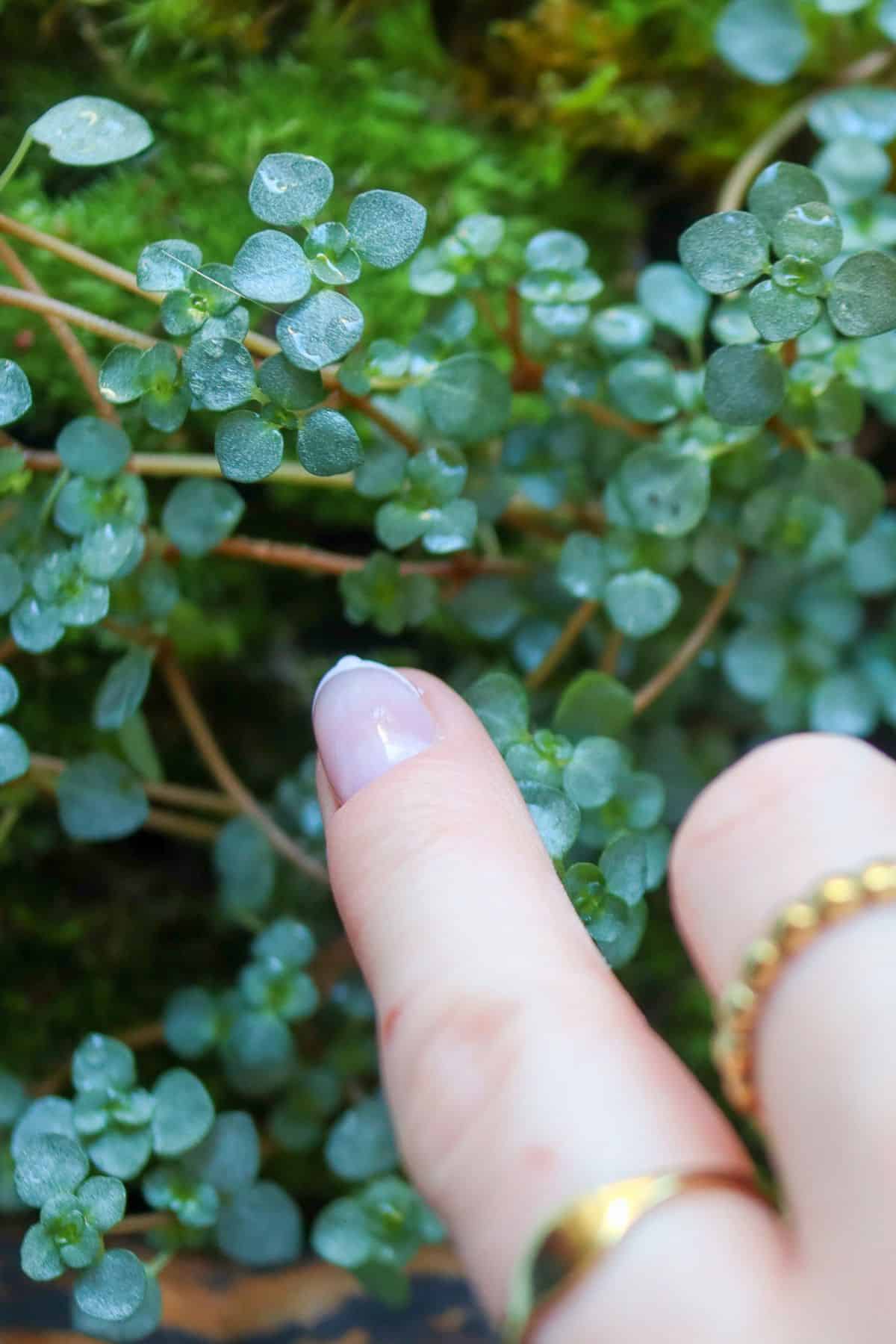
In fact, in my tiniest of builds, I tend to just stick to mosses and Pilea glauca.
Nothing provides a fantastic sense of scale quite like this delicate plant, and even in my larger terrariums, I like to sprinkle in a few cuttings.
2 | Fluffy Ruffles Fern
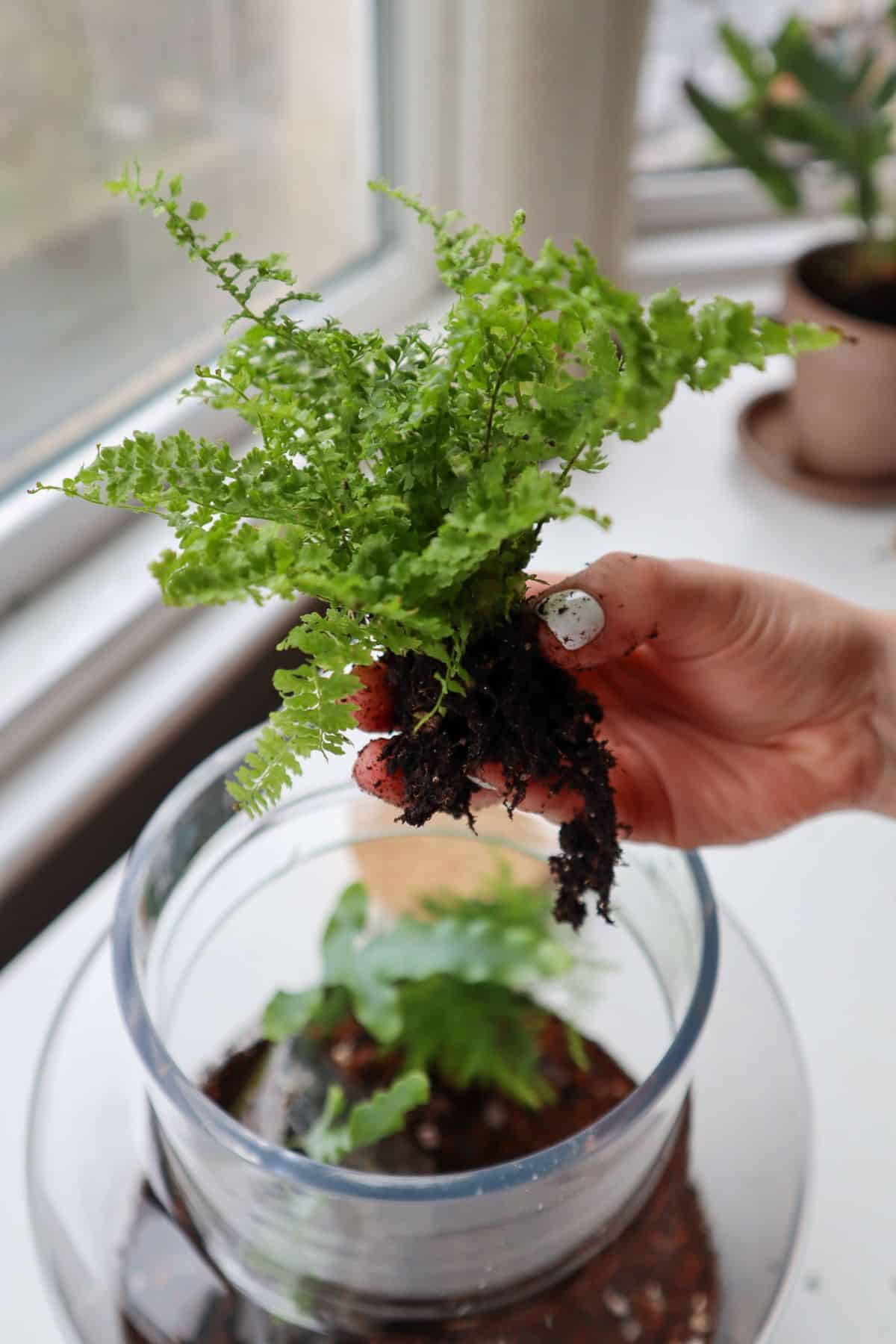
Love you a Sword Fern, but struggling with the size? I got you.
This miniature version has all the big plant energy your heart could desire wrapped up in a tiny terrarium-ready package.
Granted, it’s probably the largest plant on this list, but it’s certainly the smallest plant of its kind you can find. It’s gorgeous, fluffy fronds measure up to just a few inches tall, making it just about the cutest thing money can buy.
Even the name is cute! Fluffy Ruffles Fern? C’mon!
And that’s not all – it comes in a few colors too. I’ve seen a lovely ‘blonde’ variety online.
3 | String of Turtles (Peperomia prostrata)
A true (and worthy) terrarium plant staple.
With lime green rounded leaves and dark markings, this charming vine looks as if you have an army of baby turtles cascading across your terrarium.
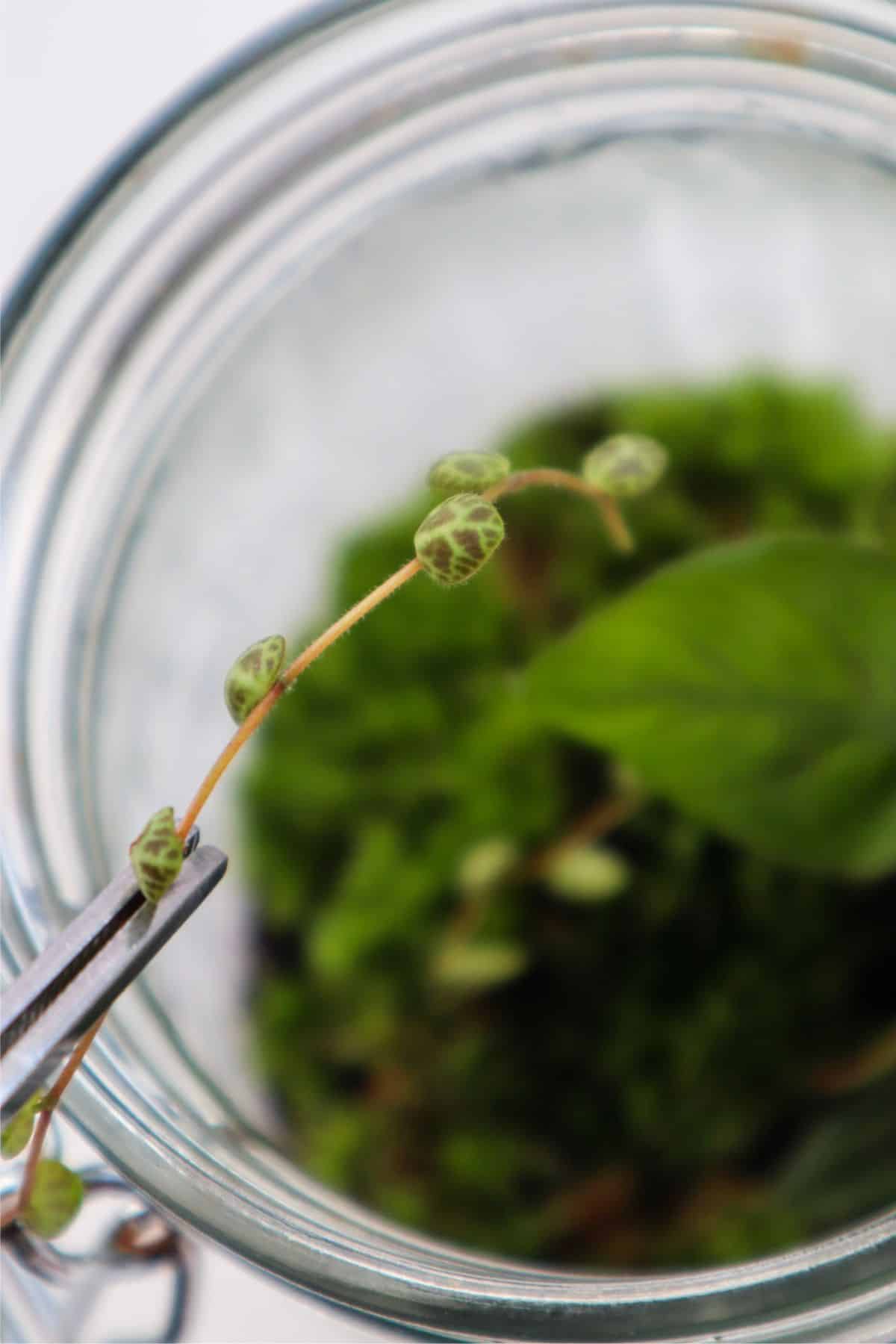
If it ever grows too long for your liking, feel free to give the String of Turtles a haircut – you can always use the cuttings for other projects.
As it’s an epiphyte in the wild, you can get away with using it in all manner of creative ways in a terrarium. Mount it up high? Drop a cutting in? You name it.
4 | Marcgravia sintenisii
Run, don’t walk to the plant store.
With foliage that first grows in a vibrant red color and gradually turns to green as it matures (creating all manner of shades in between), this shingling plant perfectly emulates the most captivating of sunsets.
This Marcgravia looks its best when mounted on some attractive hardscape or a terrarium background.
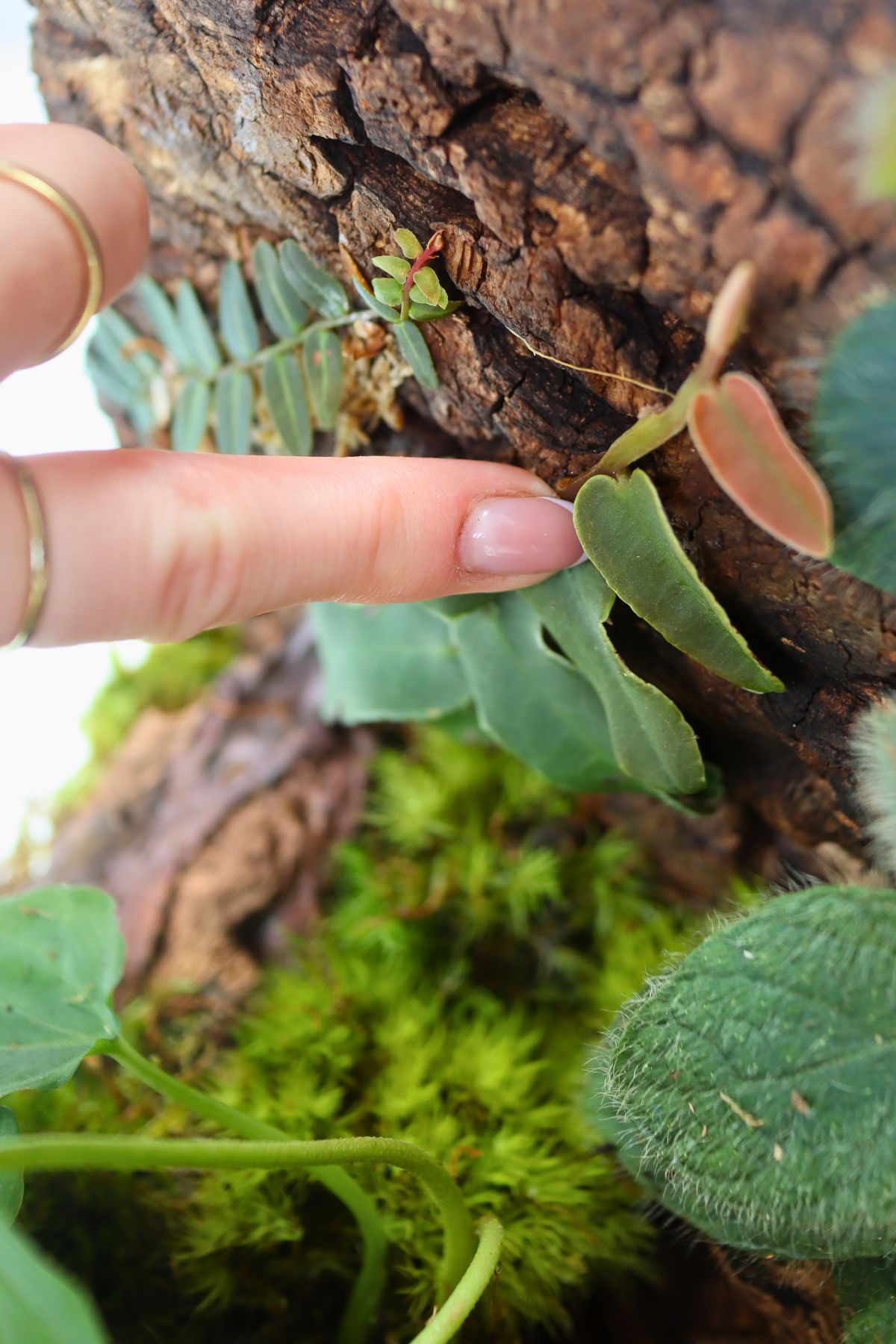
And being a plant that needs high humidity and moisture to thrive, it really couldn’t be more of a perfect fit for life inside a terrarium if it tried.
5 | Peacock Fern / Peacock Moss (Selaginella uncinata)
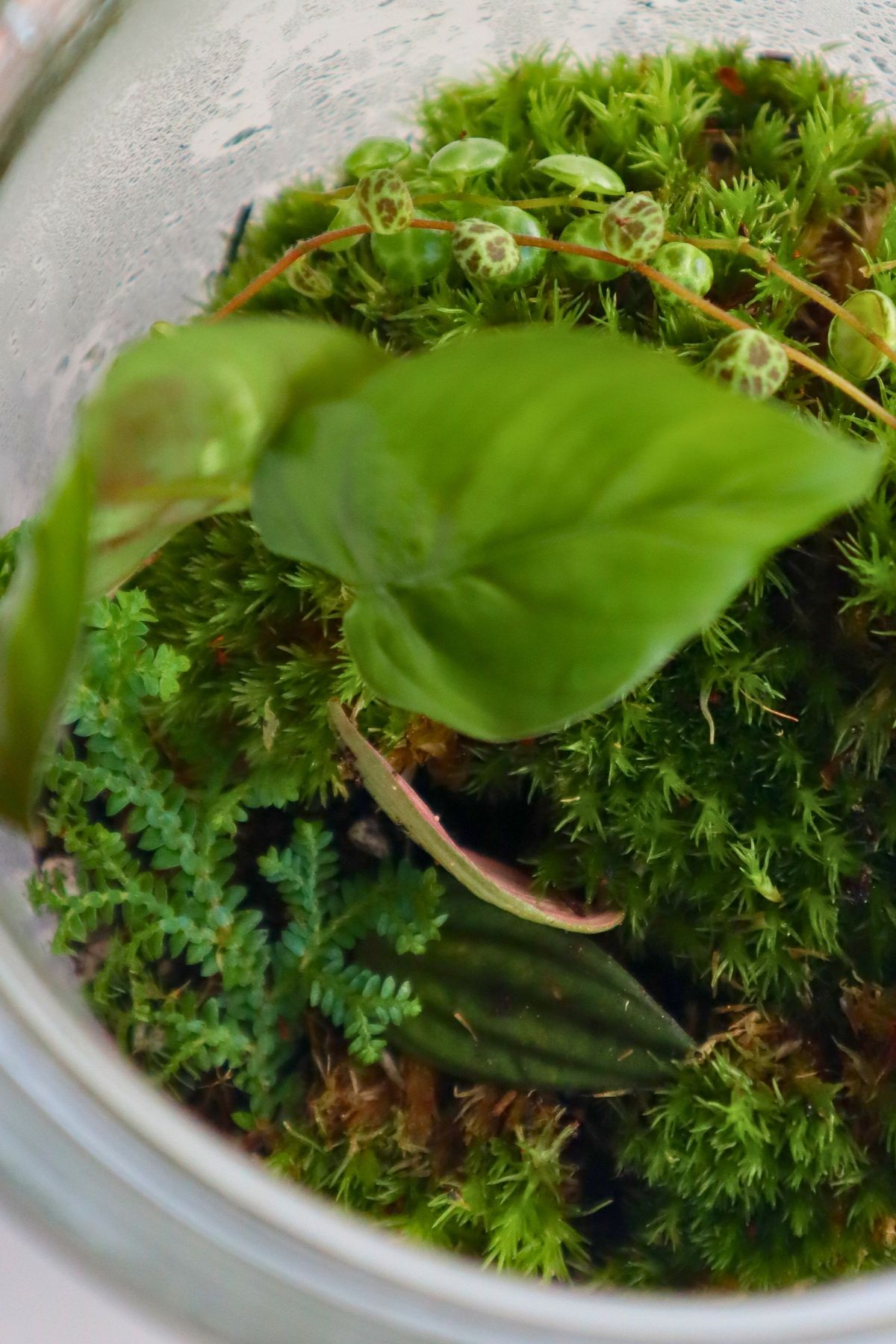
To better get to know this plant, let’s break down its common names:
Peacock – Referring to the exquisite blue-green shades and iridescent tones (yes, really).
Fern/Moss – While this plant belongs to the somewhat enigmatic Selaginella genus, it looks like the love child between (you guessed it) a fern and moss.
I keep coming back to this plant time and time again. Its dainty turquoise foliage and vein-like creeping growth pattern really stand out in a busy terrarium, providing beautiful texture and contrast.
And it thrives in indirect sunlight – ideal, right?
6 | Creeping Fig (Ficus pumila)
If you’re someone who prefers a neatly manicured terrarium, then you can safely skip this plant.
However, if, like me, you just can’t get enough of wild, luscious overgrowth, then you and this plant are going to get on tremendously.
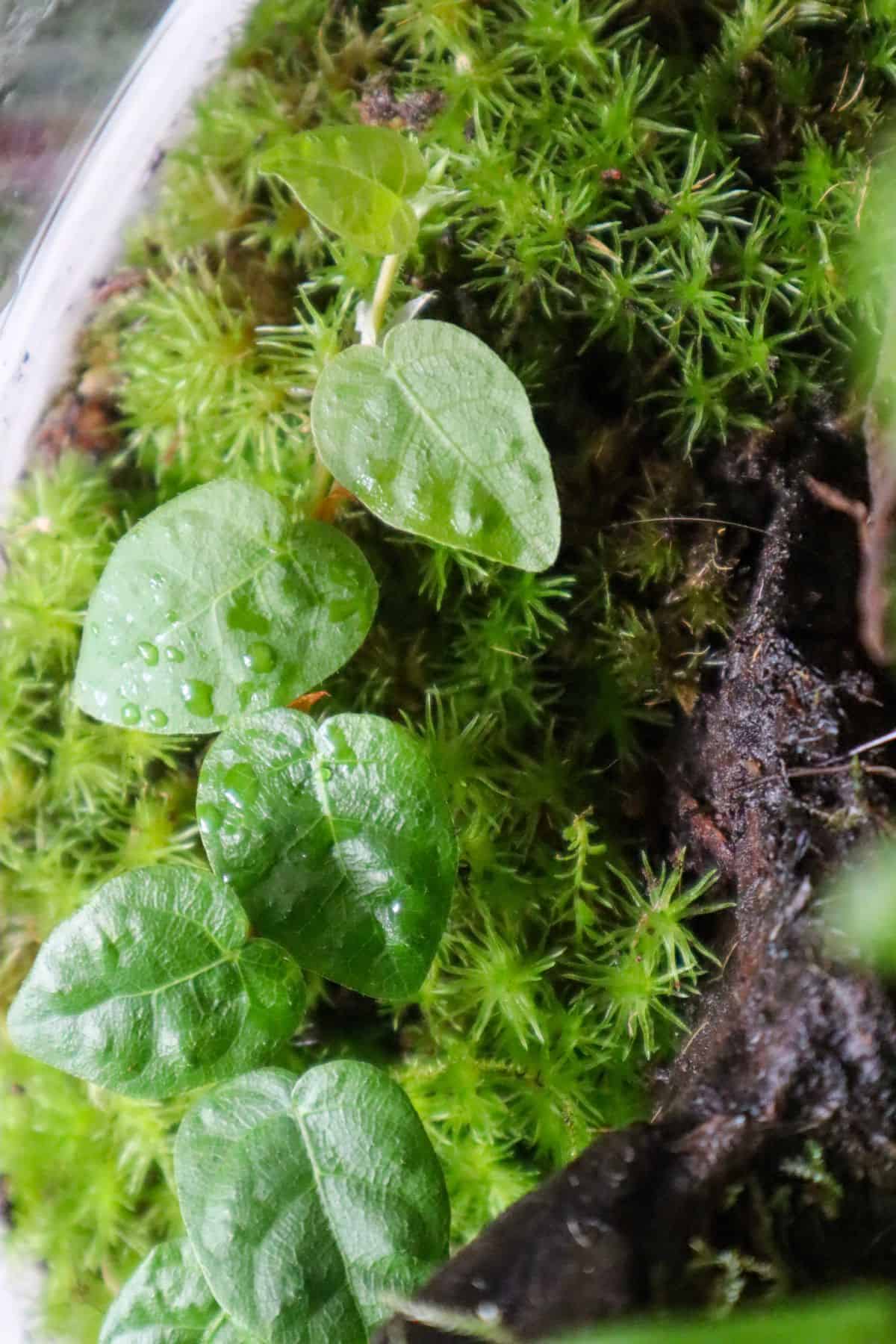
Ficus pumila is a beautiful, bright green vine and an absolute dream to work with. Simply snip a cutting, drop it in a terrarium, and let it root all by itself.
7 | Humata heterophylla

Humata heterophylla is a tropical delight. Its leaves are almost spearhead-shaped and beautifully textured with delicate ridges.
Absolutely perfect for ground cover, this unique vining fern will pop up feather-like fronds around your terrarium.
The only less-than-marvelous thing to note about this plant is that it can be a real challenge to plant due to the vining stem. Because of this, it might be easier to use this plant in a glass container with a wide opening (so you can get your hands in for the fiddly stuff).
8 | Watermelon Dischidia (Dischidia ovata)
With oval-shaped emerald green leaves and white venation, it’s easy to understand how this plant coined its common name.
It’s such an overlooked closed terrarium plant, too, so if you’re looking for a unique addition to your latest build, this could be precisely what you’re looking for.

But the good part is, that its leaves will never grow beyond their dainty size, so it can always be trimmed back to fit a small space.
9 | Mini Asian Water Fern (Bolbitis heteroclita ‘Difformis’)

Anything with ‘mini’ in the name is a good sign, right?
This lesser-known dainty darling is a fantastic choice that won’t outgrow its container.
It boasts the most delicate frilled fronds that remind me of parsley (yes, I’m running out of ways to describe plants!). You can rest assured it will add texture to just about any build and looks fantastic planted next to broader leaves.
Bonus – like many plants on this list, it can be planted epiphytically on hardscape, so it’s a perfect choice for anyone looking to up their terrarium game.
10 | Nerve Plant (Fittonia)

As far as I know, it’s illegal to create a terrarium plant round-up without including Fittonia, and I’m certainly not looking for trouble with the plant police.
They’re extremely popular terrarium plants, and for good reason.
Fittonia is actually a genus, not a specific plant, encompassing all sorts of bright species and varieties, the most common being albivenis and verschaffeltii.
You’ll find all sorts of shades and can easily identify them by the signature striking venation, almost always in a bold, contrasting color.
This makes Fittonia look more ornamental than natural, making it a perfect choice for anyone wanting to add a striking feature plant or a fun splash of color to their build.
*Bonus* Mood Moss (Dicranum scoparium)

No terrarium is complete without moss, and there’s no way this list could be complete without mentioning one.
Let me introduce you to my all-time favorite: Mood Moss.
She’s versatile. She’s fluffy. She’s vibrant. There’s nothing not to love.
And I can guarantee there’s no container it won’t comfortably fit in. Even with the likes of terrarium jewelry, you can still squeeze in a tuft of this luscious moss!
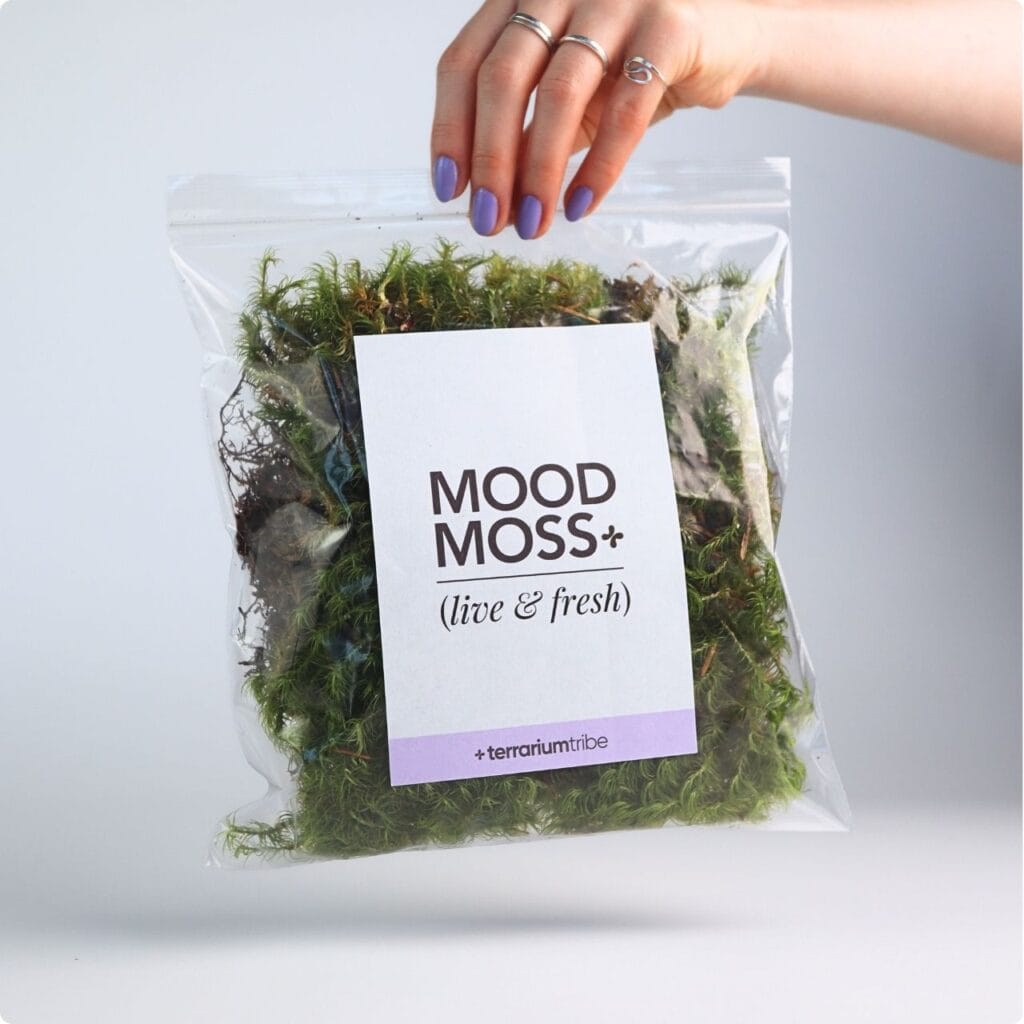
Live Mood Moss
A rich green moss with spiky, windswept growth that adds texture and movement to terrariums.
Dynamic form • Emerald green
Being an acrocarpous moss (meaning it grows in clumps instead of sheets), you can tease it apart into smaller chunks, making it super easy to place, even in limited space.
Small Plants vs Terrarium Reality
By now, it should be clear that “small” can mean a few different things in practice.
Some plants stay compact because they grow slowly, others because they creep rather than climb (and a few manage both).
But size is only one part of choosing well. A plant still needs to suit the setup, the conditions, and the role you want it to play.
For the broader plant-selection framework, start with our main terrarium plants guide.
One important caveat, though, is that small doesn’t automatically mean closed-terrarium friendly. If you’re planning a sealed build, it’s worth cross-checking your picks against these reliable plants for closed terrariums.

Glad to find you guys and be able to pine for so many of the largely unattainable botanical goodies.
Thanks!
This is wonderful! Thank you so much. I’ve built terrariums in those giant pickle jars as a kid. I totally admit, I had no more than a slight idea what I was doing. Mainly some moisture loving plants and dirt in a jar with some pretty rocks. Now that I am looking to expand my plant collection into containment. I bought a kinda big apothecary jar and want to plant it. As opposed to when I was a kid, I know I don’t know how. So glad I found this site. I’ve got 4 tabs open and just finished reading this article. Hoping to find a how to- exactly build my first real terrarium. Got the plants picked out and some of the deco items as well as a mix of moss and lichens. I’ll probably go fetch a pretty rock from the yard, hopefully to attach something to. Thanks again, I can’t wait to learn more!
It’s so exciting to hear you’re picking up the hobby in adulthood! It sounds like you’re ready to go ☺️
Do you have a package deal for all of the 10 plants shown in this article? I would be very interested in putting these in my terrarium.
Not yet Alex, but maybe one day!
Just a shout out to let you know what a great writer you are! Your article gave me the information i needed, and because your writing style communicated your love of your craft, was a pleasure to read. Thank you for saving me from another “dry” plant article!
Ah Marianne this made my day ❤️