

A closed terrarium is a sealed, self-watering miniature ecosystem.
Build it well, and it can run for years with very little intervention from you. That kind of longevity isn’t luck – it comes from getting the structure right from the start, and resisting the urge to “just give it a little more water.”
In this guide, you’ll learn how to build a closed terrarium from the ground up, creating something that looks good from day one and settles into a healthy, balanced ecosystem.

- What is a Closed Terrarium?
- How to Make a Closed Terrarium (Quick Overview)
- What You Need to Make a Closed Terrarium
- Closed Terrarium Layers (Step-by-Step)
- Best Plants for a Closed Terrarium
- Closed Terrarium Care & Maintenance
- Common Closed Terrarium Problems (and Fixes)
- How a Closed Terrarium Ecosystem Works
- How Long Do Closed Terrariums Last?
- The One Rule of a Sealed System
- Closed Terrarium FAQ's
What is a Closed Terrarium?
A closed terrarium is a sealed glass container designed to grow moisture-loving plants in a stable, humid environment.
Once planted and closed up, it begins to create its own water cycle. Moisture evaporates from the soil and leaves, condenses on the glass, and falls back down again. The system reuses the same water over and over, which is why a well-built closed terrarium can go months – sometimes longer – without watering.
The defining characteristic is the seal itself.
By trapping humidity inside, the container becomes a consistent microclimate that allows tropical plants (and many temperate woodland species) like ferns, mosses, and small foliage plants to thrive.

At its best, a closed terrarium isn’t just decorative. It’s a contained living landscape – steady, humid, and designed to stay that way.
How to Make a Closed Terrarium (Quick Overview)
At its core, a closed terrarium build is a carefully layered system designed to support your plants, boost humidity, and retain moisture where it matters.
The build itself follows a clear sequence:
- Choose a clear glass container with a lid. It doesn’t need to be airtight, but it should retain humidity reliably.
- Add a drainage layer (LECA clay balls work well) about 1 inch deep.
- Separate the drainage and substrate with mesh or long-fibre sphagnum moss.
- Add a tropical substrate mix that holds moisture but stays airy.
- Plant compact, humidity-loving species.
- Lightly moisten the substrate – damp, not saturated.
- Seal the container and let the system settle.
That’s the foundation. The details below explain why each layer matters and how to get the balance right the first time.
For a more hands-on walkthrough of the full assembly process, see our guide to building a terrarium from the ground up.
What You Need to Make a Closed Terrarium
Most closed terrarium builds rely on the same core components.
However you style it, every sealed system needs three things: drainage, structure, and a growing medium.
In practical terms, that means a clear glass container with a lid, a drainage material such as LECA clay balls (or lava rock), and a tropical substrate mix that retains moisture while staying airy. You’ll also want hardscape elements like rocks or cork bark, compact humidity-loving plants, and a small cleanup crew of springtails to keep mold in check.
Basic tools – long tweezers, scissors, and a spray bottle – aren’t necessarily essential, but can really help.
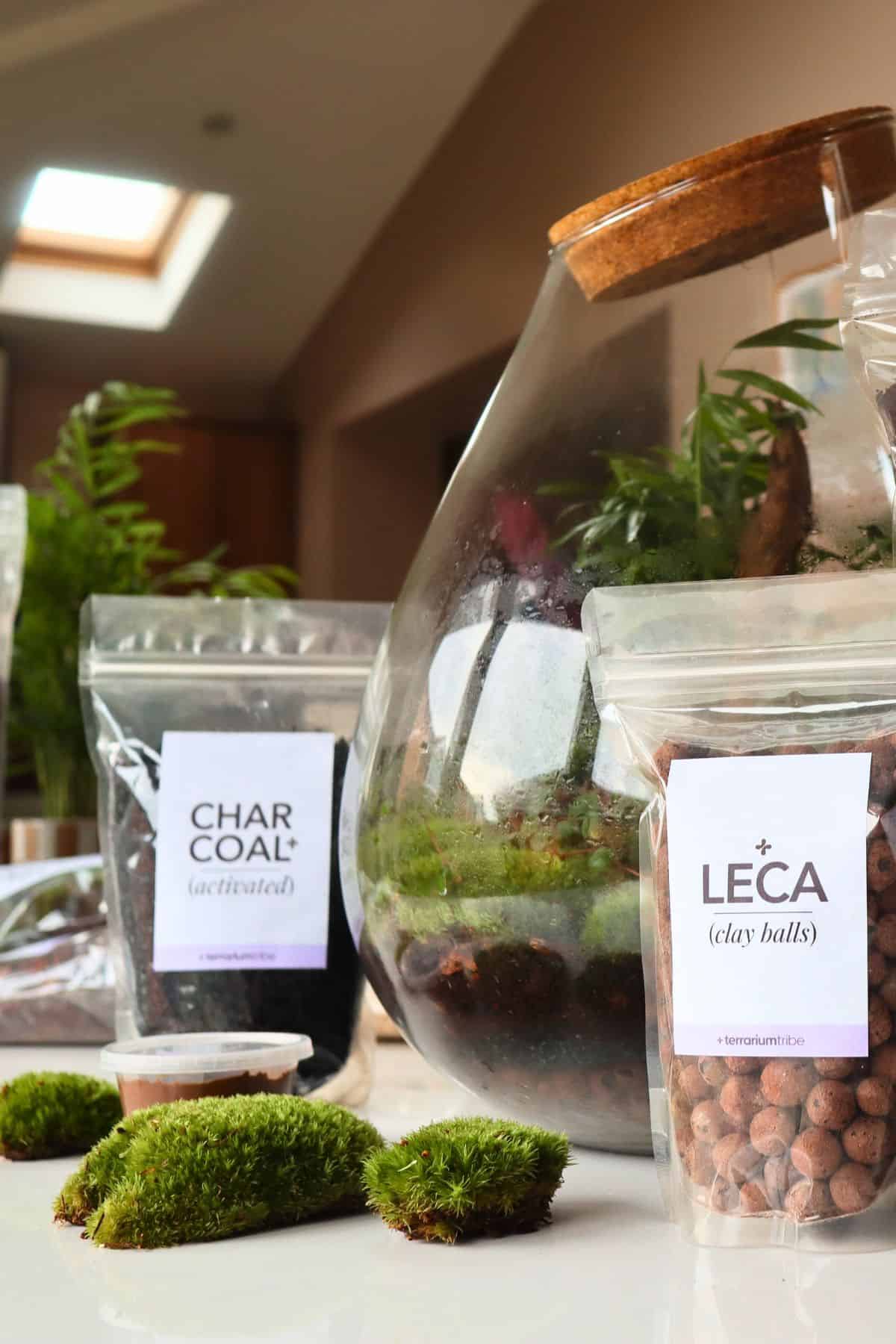
Material choice does matter, as certain materials consistently outperform others.
LECA, for example, tends to work way better than gravel or river stones in sealed systems. Its porosity improves airflow at the base and absorbs excess moisture, rather than just letting it sit beneath the substrate (which helps reduce the risk of root rot).
The substrate matters even more. Many long-term issues trace back to soil that compacts or holds too much water. A proper tropical mix stays loose, drains well, and still retains enough moisture to keep plants hydrated.
As for containers? Suitable glassware turns up in unexpected places. Apothecary jars, spice jars, whisky bottles, even old candle jars can work – provided they’re clean and capable of holding humidity.
We cover this in detail in our guide to choosing the right terrarium container.
And despite common assumptions, the lid doesn’t need to be perfectly airtight. It just needs to retain moisture consistently.

If you find a container you love that doesn’t come with a lid, I’ve broken down the most reliable approaches in this guide to practical terrarium lid solutions.
Closed Terrarium Layers (Step-by-Step)
Building a closed terrarium is a lot like building a house.
You’ll need a good foundation, lots of support, and plenty of drainage. The structure is key, with each of the distinct terrarium layers playing a specific role in moisture control and plant health.
1. Drainage Layer
This is your moisture buffer.
Use LECA clay balls to create a base reservoir, around 1 inch (2 cm) deep. In a sealed system, excess water has nowhere to escape, so this layer gives it somewhere to collect instead of saturating roots.
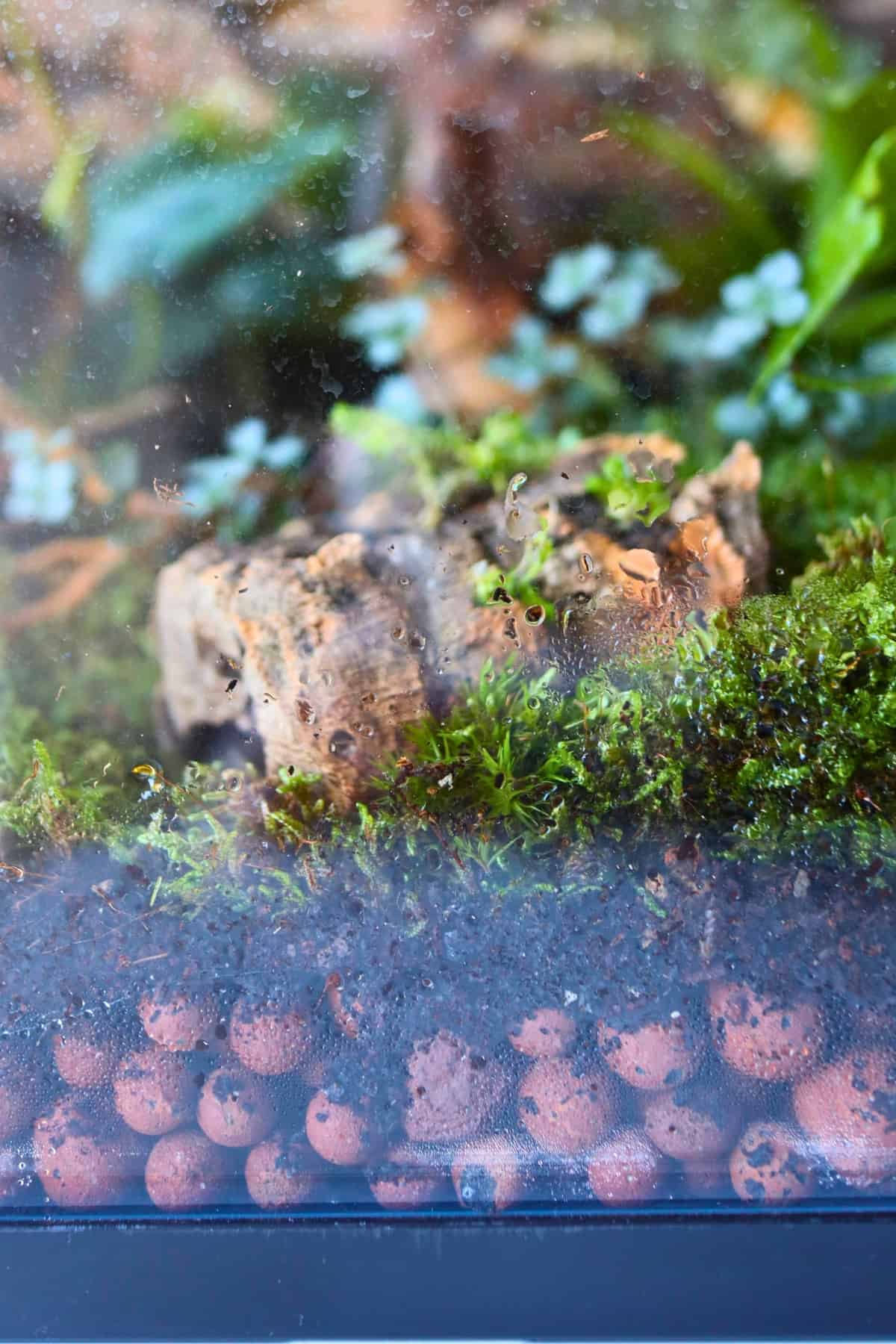
There are a variety of ways to build a false bottom/drainage layer – and you can use other strong, porous materials – but even this simple LECA layer goes a long way.
2. Barrier/Separation Layer
This layer sits between the drainage material and the substrate above.
Its job is simple: keep the two layers distinct over time. Without some form of separation, fine particles gradually work their way down into the drainage layer, compromising its effectiveness and compacting the base of the build.
You can use a fine mesh barrier or a thin layer of long-fibre sphagnum moss. Both achieve the same goal.

In our builds, we tend to prefer mesh because it holds its structure indefinitely and doesn’t decompose. Sphagnum works well, too, but it will slowly break down as the system matures.
3. Activated Charcoal (*Optional but Recommended)
Activated charcoal can sit above the mesh as a distinct layer, or it can be sprinkled elsewhere throughout the layers.
In a closed environment, it helps adsorb impurities and organic compounds as water cycles through the substrate. It’s not a substitute for good structure, but it adds an extra buffer against stagnation and odor.
It’s not an exact science, but a thin, even layer is enough.
4. Substrate Layer
The substrate is where your plants will live and root.
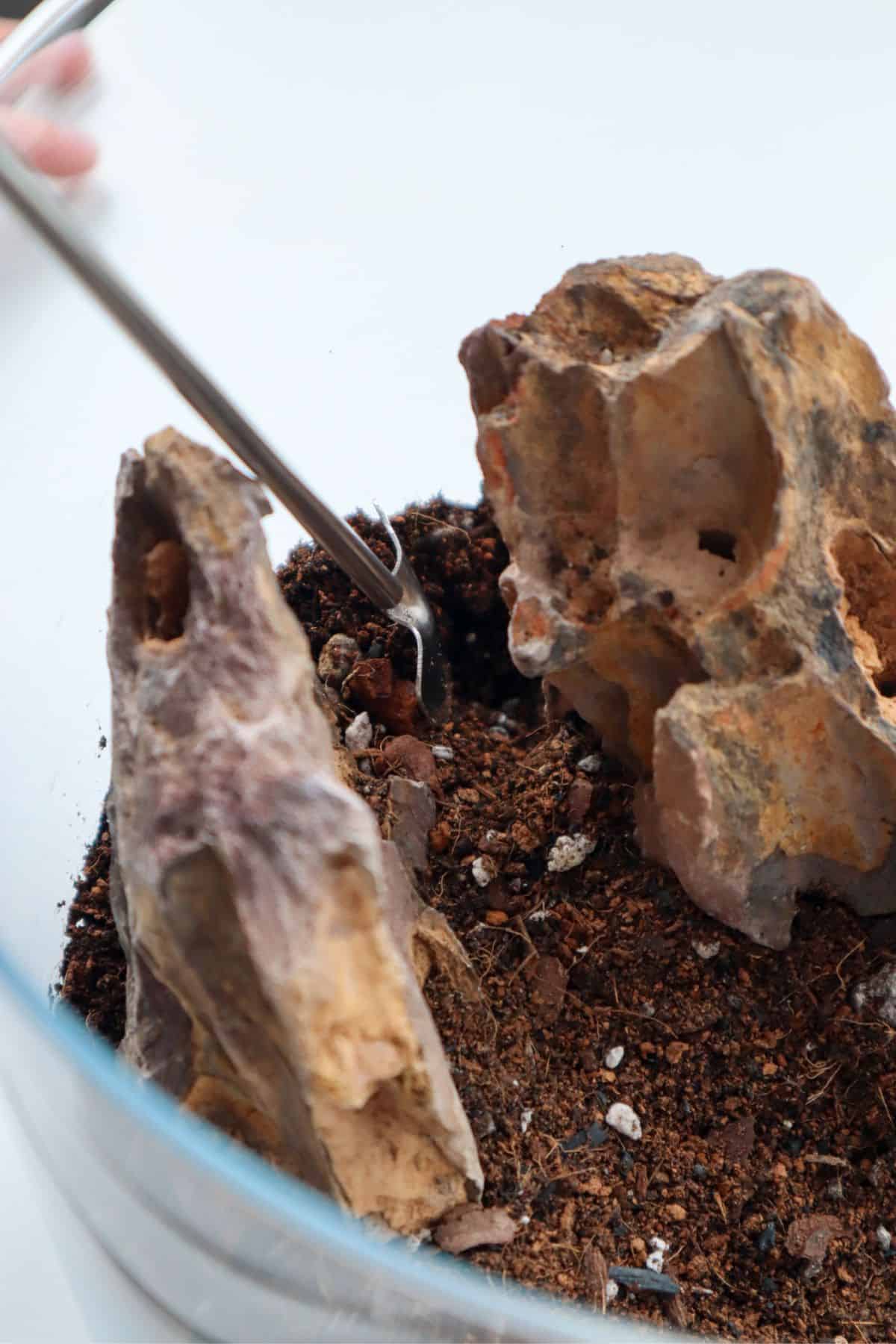
Add enough substrate to comfortably support the roots of your largest plant – usually around 3–4 inches (7–10 cm), depending on container size. It should be deep enough to anchor plants securely, but not so deep that it dominates the vertical space.
You typically want these layers combined to take up around 1/4 of the container to maintain visual balance – you can also slope the substrate from back to front to maximize visual depth without adding more material.
5. Hardscape & Surface Layer
Hardscape gives the terrarium its physical framework and sense of flow.
Rocks and wood aren’t just decorative – they create anchor points for roots and shape the overall growth pattern of the build.
Place and secure hardscape before planting. Once roots establish, repositioning larger elements can disturb far more than it appears. Anchor pieces firmly into the substrate so they won’t shift as the system matures.
Once the structural elements are set, the terrarium is structurally complete and ready for planting.
Best Plants for a Closed Terrarium
The best plants for a closed terrarium are compact tropical species that tolerate high humidity, low airflow, and indirect light.
Rather than thinking in terms of individual species straight away, it helps to think in broad plant types. The combinations tend to work better.
Good closed terrarium plant categories include:
- Ferns
- Vining plants
- Foliage plants
- Tropical mosses
- Small epiphytes
What doesn’t work are plants adapted to dry conditions. Succulents and cacti rot quickly in sealed environments, no matter how carefully you water them.

For specific species recommendations and growth habits, see our hand-picked list of the best plants for closed terrariums.
Closed Terrarium Care & Maintenance
Once a closed terrarium is established, the job changes.
You’re not really “looking after” it in the traditional sense anymore, or following a care routine. You’re paying attention to how the system is behaving – how moisture is cycling, how plants are growing, how the glass looks throughout the day.
Some variables are (mostly) best left alone once they’re set. Others, like positioning and light, are easy to adjust if growth looks unbalanced. The trick is knowing the difference.
For a broader breakdown of long-term care, see our full terrarium care guide.
Most of the time, small, deliberate changes are enough. Closed systems don’t usually need dramatic fixes – just occasional nudges in the right direction.
Watering
Water is the variable that makes or breaks most closed terrariums.
Once the lid goes on, you’re not following a watering schedule anymore. You’re setting the moisture level for an enclosed system that will recycle that water on its own.
In our experience, most long-term issues trace back to starting too wet rather than too dry. A lightly moist substrate is enough. It should feel damp, not saturated. Excess water has nowhere to drain and can take a long time to work itself back into balance.
In practice, condensation levels are a better indicator of balance than soil moisture.
If you ever do need to add water later on, add less than you think. A small adjustment is usually all it takes. It’s easy to add more. It’s surprisingly difficult to take it back out.

For a more detailed walkthrough, see our guide on how to water a terrarium.
Oh, and don’t use tap water. The minerals in tap water will cause a buildup on the glass that can make it look smeared – use distilled water where possible.
Lighting
Lighting is often the most overlooked variable in a closed terrarium.
It’s the easiest to adjust, but not the easiest to get right (and it’s constantly changing through daily and monthly cycles).
Closed terrarium plants consistently perform best in bright, indirect light. Near a window is usually ideal, but out of direct sun. What tends to work best over time is consistency. Steady, moderate light produces compact, balanced growth.
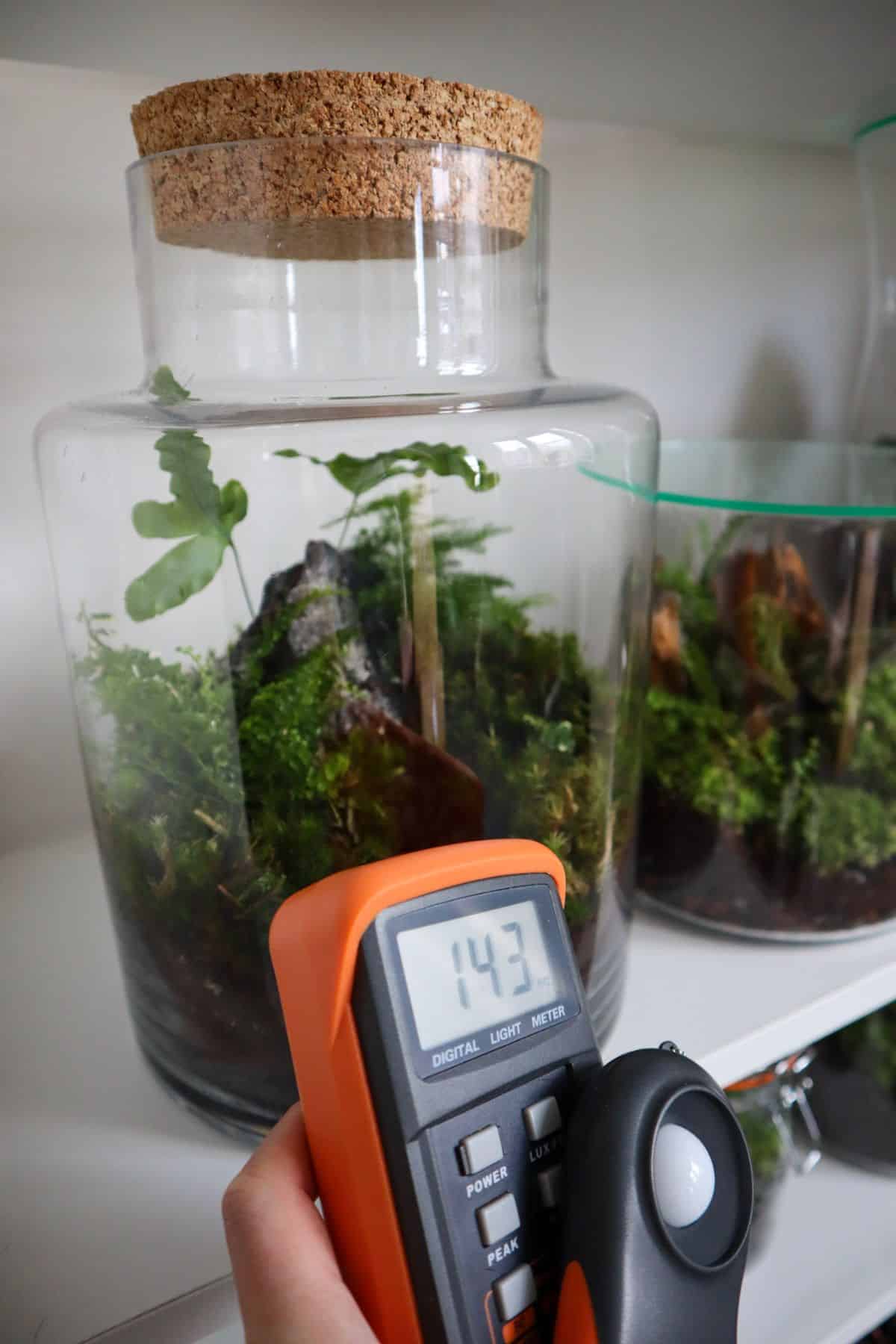
The advantage is that light is easy to tweak. Move it slightly closer. Pull it back a touch. Add a soft grow light if natural light is limited. Small adjustments tend to show results within weeks.
Common Closed Terrarium Problems (and Fixes)
Nearly all closed terrarium issues fall into a few familiar patterns. Once you know what to look for, they’re usually straightforward to correct – and most tie back to the same common terrarium care issues.
Too much condensation
If the glass is heavily dripping or fogged, there’s too much moisture trapped inside.
This usually isn’t a big deal. It looks more dramatic than it is. Cracking the lid for a short while to let some humidity escape is often enough to bring things back into balance.
No condensation
If the glass stays completely clear, the system is likely running too dry. You definitely want to see a light fogging of the glass throughout the day. Add a small amount of water and give it time to re-establish the water cycle.
Our guide to terrarium condensation walks through all aspects, from too much to too little.
Mold growth
A bit of mold is very common in new terrariums, especially in the first few weeks. Annoying, yes. Unusual, no.
Most of the time, it settles on its own as the system stabilizes (give it a few weeks). That said, introducing springtails can really help get on top of mold in the long term. The earlier you can add them, the better.
Our guide to mold in terrariums outlines everything you need to know.
Yellowing plants
This one can be frustrating, mostly because the plant rarely bothers to explain itself. In closed terrariums, though, it’s often down to light rather than water. If growth looks pale or weak, try nudging the light levels up slightly before changing anything else.
How a Closed Terrarium Ecosystem Works
Sealing a terrarium doesn’t just trap moisture – it links everything inside the glass.
Plants respire, releasing moisture and exchanging gases. Microorganisms in the substrate break down organic matter. Condensation forms and returns water to the soil. Over time, these processes begin to reinforce one another.

That interdependence is what gives a closed terrarium its stability – and its sensitivity.
When the balance is right, the system settles into a steady rhythm. Plants grow at a manageable pace, condensation rises and falls predictably, and nutrients are recycled back into the substrate.
This is also where bioactivity becomes powerful.
Springtails and beneficial microbes don’t just “clean up” – they complete the nutrient cycle. Decaying leaves are broken down, mold is suppressed, and organic matter is converted back into usable resources for plant roots.

When plant size, moisture balance, and bioactivity are aligned, the terrarium begins to regulate itself. That’s what people really mean when they talk about a self-sustaining terrarium. If you want a deeper look at what’s happening inside the glass, we break these processes down in more detail in our scientific guide on how terrariums work.
Other invertebrates (like isopods) can also work in closed terrariums, provided there is some level of air exchange. A partial seal or occasional opening allows enough airflow for them to remain healthy over time.
Larger animals, however, aren’t suited to fully sealed environments. Closed terrariums are designed as plant-led ecosystems. They don’t provide the airflow, space, or environmental control that reptiles, amphibians, and larger bug pets (e.g., beetles) would require.
How Long Do Closed Terrariums Last?
Longer than you might expect.
When a closed terrarium is structured properly, it can absolutely last for years.
In practice, the ones that last all share the same foundations. A drainage layer that actually absorbs excess moisture. A substrate that stays airy instead of compacting. Plants that don’t outgrow the space within months. Steady light instead of dramatic swings.
Get those right, and the system slowly settles into rhythm.
That doesn’t mean nothing ever changes. Plants grow. Moss thickens. You may trim occasionally. But a well-built closed terrarium shouldn’t feel fragile or high-maintenance. It should feel steady.
There are even documented sealed terrariums that have been going for decades without ever opening them. Are they in pristine shape? Not exactly – most have taken on a particular wildness, but that’s part of the fun. Watching our creations grow and evolve.
We’ve written more about what actually determines terrarium lifespan if you’d like to go deeper.
The One Rule of a Sealed System
A closed terrarium doesn’t give you many controls, and that’s kind of the point.
Once the lid goes on, the system has to regulate itself. The plants, materials, and (if you’re using them) bioactive bugs you choose to put inside all need to work together over the long-term.
That’s why it’s worth thinking about the system as a whole right from the beginning.
In practice, these systems reward careful setup far more than active correction. More often than not, it’s actually the overwatering, tweaking, or well-intentioned “help” that nudges things out of rhythm in the first place.
So if there’s one guiding principle, it’s this: set it up so you can leave it alone.
Get that part right, and the rest falls into place.
Closed Terrarium FAQ’s
For a healthy plant ecosystem, yes. Though plants consume carbon dioxide for photosynthesis, their roots (along with soil microbes) need oxygen. But thankfully, a planted closed terrarium can recycle gases internally, so you don’t need to actively manage the oxygen supply.
A well-balanced closed terrarium can often go months without added water, and some sealed systems can go much longer. Containers with a strong seal tend to last longer without watering.
A healthy closed terrarium should smell earthy, not sour or rotten. Bad smells usually point to too much water, rotting plant material, compacted substrate, or poor airflow through the lower layers.

I decided to build my own terrarium one from a 2 gallon water container with a spout and one in a lg Lance cracker container. Today they have lots of condensation. I am 81 yrs old and really enjoyed gathering up the plants for it. I hope it works.
Lovely to hear ☺️
I bought a cork lid for my glass terrarium but unfortunately didn’t realise the glass was slightly warped; the lid won’t fit and it chipped the sides of the opening quite badly (my fault.) so I’m lidless. However, the cork lid is tapered; can I simply turn it upside down and lay it atop the opening (rather than corking it into the opening like a seal) to get the required degree of “closed” to be a closed terrarium?
Absolutely! It doesn’t need to be properly sealed. 🙂
I just started putting my first terrarium together – I got hold of a “dinosaur terrarium” kit for nothing, and have junked everything except the glass terrarium, cork lid and remote control led light.
I’ve got some moss and a lemon button fern on the way (it really is a tiny terrarium), and have started the ball rolling by putting in a clay-type drainage layer, some carbon, and a layer of compost. a small piece of dragon rock is in place to give a little hardscape interest.
Sadly I can’t include a picture here, but so far it’s looking good – despite the lack of a focal plant or moss to cover the soil!