
Self-sustaining terrariums sound almost too good to be true.
Build it once, seal it up, and… let it run?
In practice, a real self-sustaining terrarium isn’t a special kit or a secret formula. It’s what happens when a closed system is built correctly – with the right structure, carefully selected plants, and the right balance from the start.
Get those fundamentals right, and the ecosystem largely regulates itself.
In this guide, we’ll look at what actually makes a terrarium self-sustaining – and how to stack the odds in your favor from the start.
How Does a Self-Sustaining Terrarium Work?
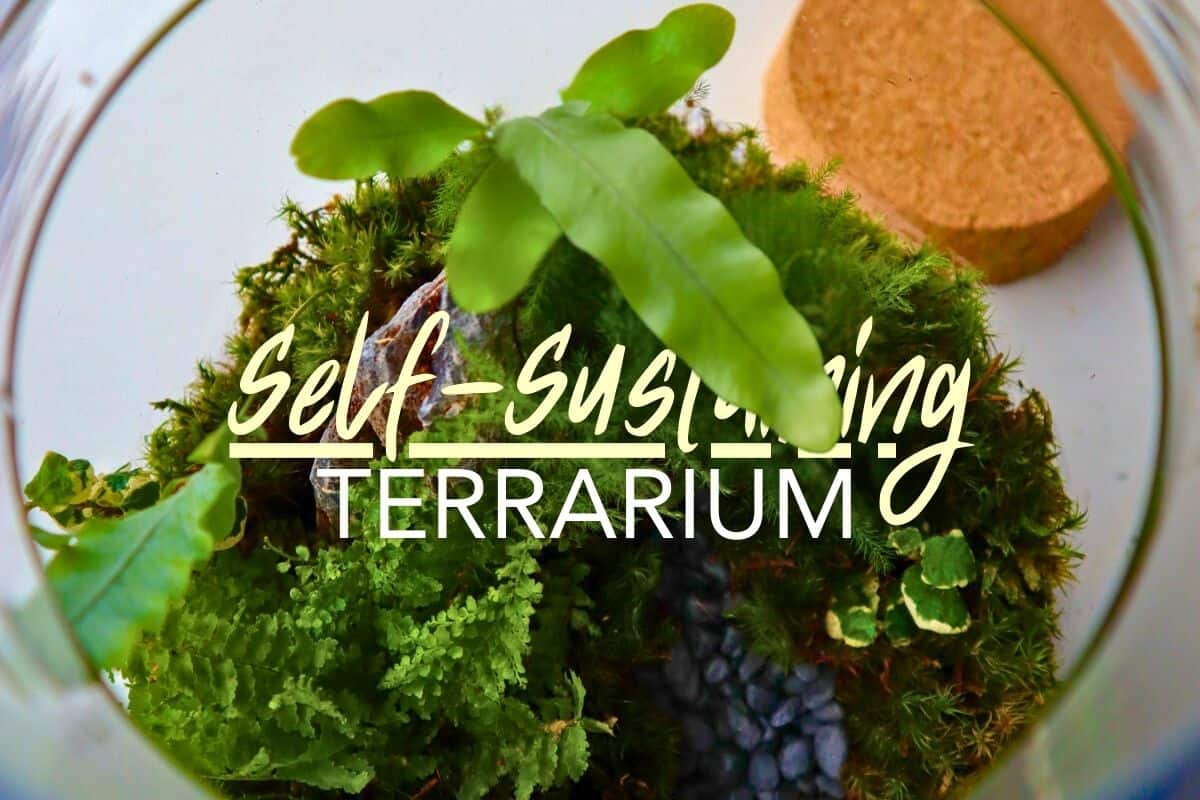
A self-sustaining terrarium works by recreating a natural ecosystem inside a sealed container.
When the environment is closed, water evaporates from the soil and plants, condenses on the glass, and falls back down again – creating a continuous internal water cycle. Given a little time, the internal conditions level out and the system stabilizes.
At the same time, plants exchange gases and microorganisms recycle nutrients within the system.
Nothing is wasted, everything circulates, and the “Circle of Life” continues (just on the micro scale).
In other words, a self-sustaining terrarium isn’t a special kind of build. It’s the result of a well-built closed terrarium – shaped by thoughtful plant selection, appropriate materials, and (potentially) the right microfauna to support a balanced ecosystem.
In the rest of this guide, we’ll break down those components so you can build a terrarium that genuinely sustains itself.

How to Make a Terrarium That Sustains Itself
Setting up a self-sustaining terrarium isn’t complicated, but it does require understanding how each component supports long-term balance.
Starting Setup Guide
To set up a self-sustaining terrarium that actually works long term, you need to get five things right:
- A sealed glass container that maintains stable humidity
- A foundation that manages moisture without becoming stagnant.
- Plants that grow at compatible rates (manageable and unlikely to outgrow the space).
- Optional microfauna to support nutrient recycling.
- Enough restraint to let the system settle without constant interference.
Each of these choices affects the others.
Too many plants compete for light and resources. Too much water leads to rot and persistent mold. Most problems start with adding more than the system can comfortably support (now and in the future).
Get the structure right from the start, and the ecosystem will do most of the work for you.
Let’s break down how each piece contributes to that balance.
1. Choose Suitable Plants That Grow in Balance
Your choice of plants says a lot about the kind of environment you want to create.
If you want a healthy mix that will thrive together in the long term, I recommend steering towards these three plant qualities.
- Select terrarium plants that will grow well (but not too well).
- Opt for plants that are hardy and, ideally, pest/disease resistant.
- Provide enough plant biomass to sustain the natural cycles of the terrarium.
We’re aiming for growth in balance.
Overgrowth leads to plants out-competing each other, and that’s never good. The best way to get around this problem is to choose the right terrarium plants that won’t outgrow each other or the container – even when fully mature.
That’s why dwarf varieties and curated miniature terrarium plants will be your best friends here, e.g.,
- Foliage: Biophytum sensitivum (Little Tree Plant).
- Vine: Pilea glauca ‘Aquamarine.’
- Fern: Nephrolepis cordifolia ‘Duffii’ (Lemon Button Fern)

2. Build a Moisture-Supporting Foundation
A functioning water cycle is the lifeblood of a self-sustaining ecosystem.
Just like the circulatory system in the human body, it has many moving parts and doesn’t perform well when it’s blocked.
That’s why building a terrarium foundation that supports the movement of moisture, whilst retaining it where necessary, is the key to a healthy water cycle. You’ll need:
1. A drainage layer – The base layer at the bottom of a closed terrarium where excess water can collect. It helps keep up humidity, prevents the substrate from becoming oversaturated, and helps facilitate the water cycle.
In terrariums, these are often called “false bottoms.”
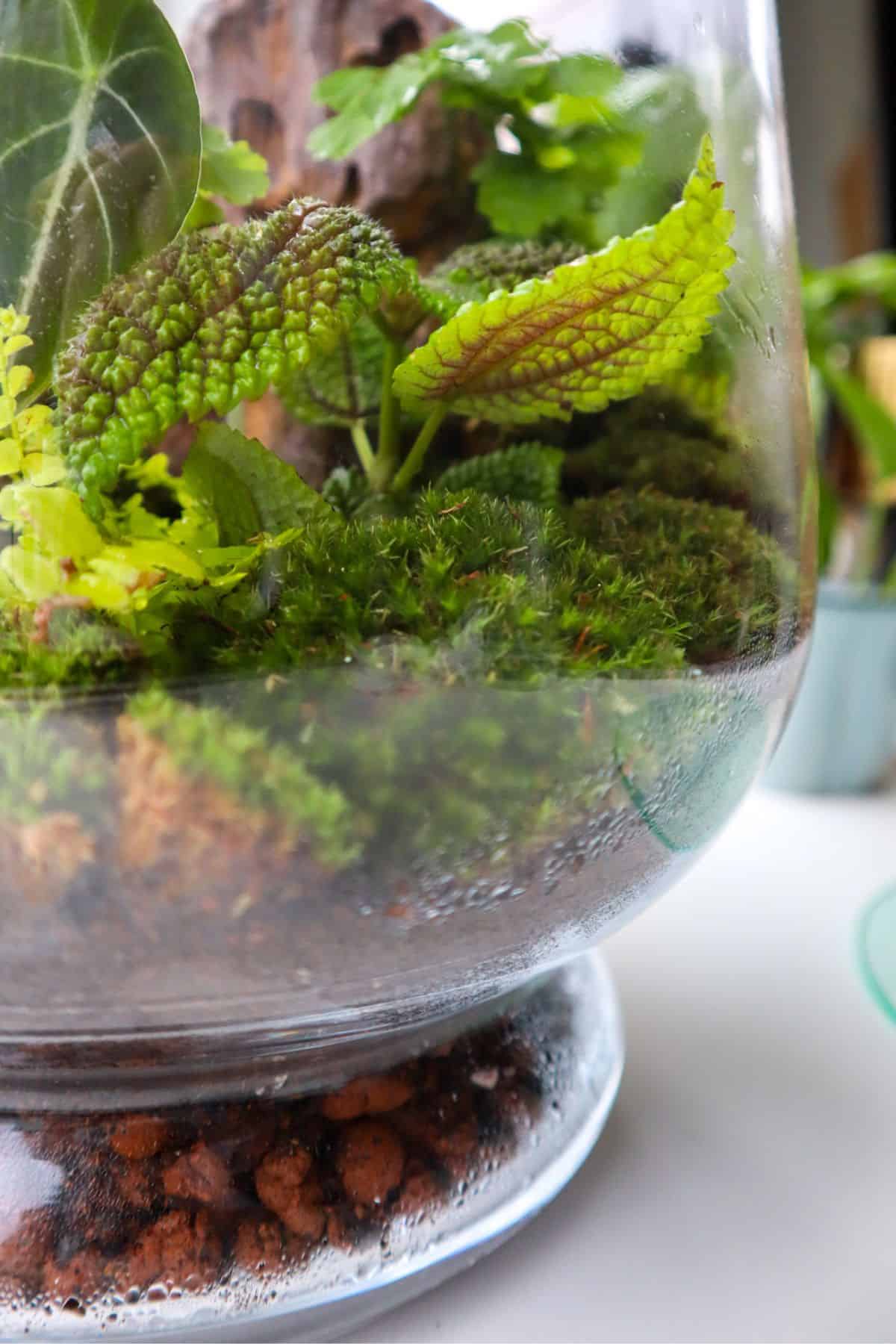
2. A balanced substrate – Having the right kind of terrarium substrate with great drainage and water retention is a critical component of any terrarium kit (i.e., not potting soil).
It also helps if it’s bioactive (meaning it helps to support the microfauna and microbial life). Our mix contains charcoal that helps seed microbial cultures and earthworm castings for organic nutrition. More on that later.
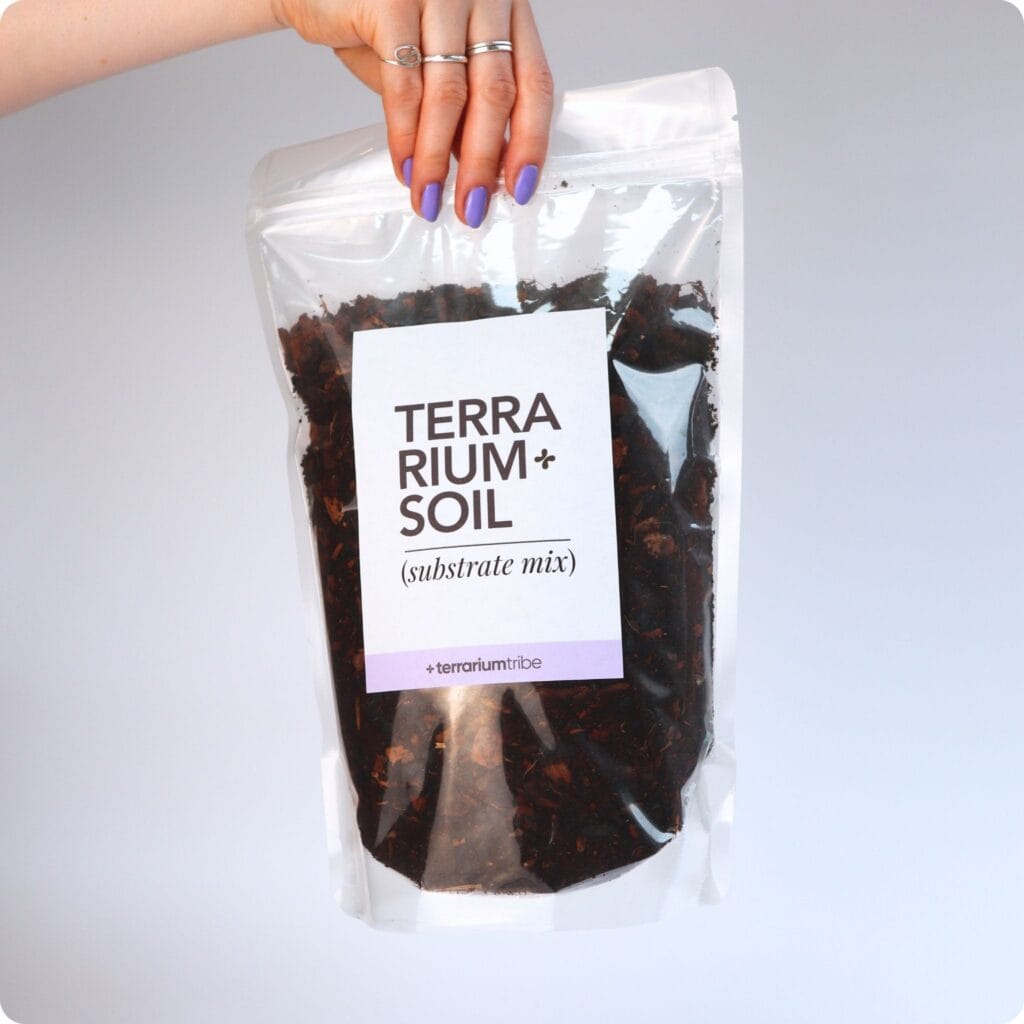
Terrarium Substrate Mix (Premium Blend)
A carefully crafted blend that balances all of your plants’ needs and sets you up for long-lasting success.
Beginner-friendly • Ready to use
3. Start With the Right Closed Container
A self-sustaining terrarium almost always means a sealed glass container.
Size doesn’t need to be enormous, but extremely small vessels are harder to stabilize. More space means more room for gas exchange, more space for plants to grow, and more resources for beneficial critters and microbial colonies.

Equally, don’t stuff your terrarium like a Thanksgiving turkey.
Overcrowding and poor circulation lead to anaerobic conditions, stale air pockets, and (usually) bad bacterial growth and rot. Hardly the woodland-fresh scent we’re going for…
4. Support the Nutrient Cycle With Microfauna
In nature, countless organisms break down organic matter to facilitate the nutrient cycle. In a terrarium, we simplify that system.
Springtails are the easiest way to keep a self-contained terrarium clean and healthy in the long term. They thrive in humidity, require virtually no care, and feed on mold – our number one closed terrarium issue.
Just pop them in, and you can say goodbye to those awful white fuzzy blooms.

Isopods can also help break down fallen leaves and organic debris, converting waste into nutrients. However, they add complexity. If your goal is a fully hands-off system, springtails alone are often sufficient.
The more animals you introduce, the more active management the system may require.
Common Problems With Self-Sustaining Terrariums
Excess Condensation
Ideally, there’d be just enough water in the system to facilitate the water cycle, with no excess moisture left over to cause any problems.
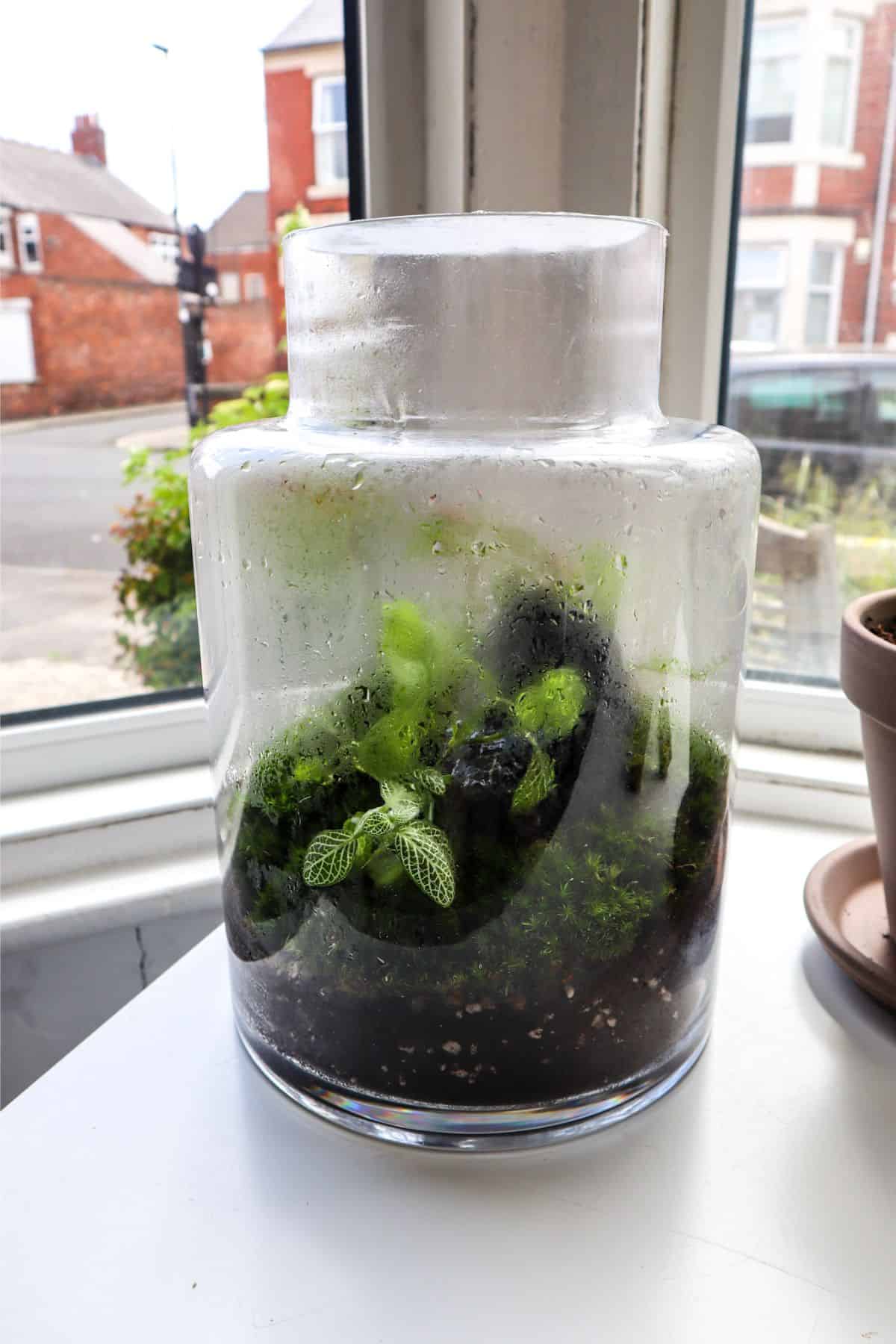
Light condensation – especially on the side facing the light – is normal (and in fact, very healthy).
However, if the glass is constantly fogged everywhere, there’s likely too much moisture in the system. You’ll need to open the lid briefly to let some water escape. Once levels normalize, the cycle should regulate itself again.
Persistent Mold Blooms
A small mold bloom during the first few weeks is common as the ecosystem settles.
If mold continues spreading, it usually signals that there’s too much water in the system. Try letting some moisture out, and if you haven’t already, add a culture of springtails – the earlier the better.

Overcrowded Growth
When foliage presses against the glass or blocks light, airflow suffers – and rot can follow.
Start with fewer plants than you think you need, and if any prove to be secretly fast growers, prune them back aggressively or remove them.

Lifespan of a Self-Sustaining Terrarium
A well-built self-sustaining terrarium can last for many years, but it won’t stay frozen in time.
Plants grow, root systems expand, and some species dominate while others fade out. Over time, the ecosystem naturally shifts.
If enclosure, plant balance, and moisture levels are (broadly) steady, the terrarium can remain functional for a very long time – even if the composition changes. The goal isn’t permanence, it’s stability.
Occasional pruning or small corrections are normal. Most systems gradually evolve, simplify, or rebalance themselves.
And that’s not failure… that’s just ecology.

Your website is awesome I make terrariums as a hobby, and I have a terrarium clôche I just made with dried/petrified grapewood and it’s producing some of those white fuzzy mold – it’s good to know springtails will take care of that!
Thanks so much! It means a lot to hear that. Yeah, driftwood can often cause mould blooms (even after it’s been boiled and scrubbed in my experience). Springtails should do the trick.
I’ve surfed . Thanks again.YouTube and your site filled in much needed info
Im buying my boyfriend the bits and bobs he needs to make a closed terrarium for Christmas, this has been a massive help, i was gonna use woodlouses, will they survive well in a closed terrarium?
I’m so glad you found it useful Ellis 😀 Absolutely, woodlice (or isopods as they’re often called in the industry) can be a great addition to a terrarium, though different species will have require slightly different conditions and might have slightly different behaviors. Experts often recommend a little ventilation for isopods too, so if your terrarium is completely sealed you might want to think about adding a small hole or opening it up semi-regularly.
I was wondering about the critter-to-ecosystem ratio, the size of the container and the biomass itself determine what a particular system can support, I reckon; any advice regarding how many and of what, that sort of thing? Thanks very much, great article.
You’re absolutely right but there’s no hard and fast rules. You typically get springtails in 16oz cultures and that’s probably enough to seed a handful of small terrariums or a single large terrarium.
I am planning on making one of these after seeing my science teachers self-sustaining terrarium and was wondering if a snail could survive in there? Also my teachers had a plastic wrap as a lid, would a regular jar lid (with no holes) work? And lastly, with a large jar, other then the aforementioned snails, what would be the best animals to have it there? There’s a lot of space to work with, I’m thinking creatures that are more on the cute side. Thank you!
I’m sure a snail could survive (though I’d add some air holes or make it a loose seal). That being said, they’ll munch all your plants so I wouldn’t personally add a snail to a plant terrarium. Most people add springtails or isopods for their cleaning function, but whether they’re cute is definitely down to personal preference – the rubber ducky ones are kinda cute 🤔
hi, I read that springtails are commonly found in garden soil, can I just take some of that?
You can, but bringing in garden soil also brings in a lot of other unknown factors (e.g. bacteria, fungus, etc) so there’s an extra element of risk to your terrarium.
Oh, and also I just have a one gallon mason jar (don’t ask), would that work as a container?
Absolutely!
Hi! I’m planning to create connected biospheres. One terrarium, one desserted and one aquatic. More of like a mini world. Is that possible?
Really interesting concept! A terrarium connected to an aquarium might work as it’ll help to boost the ambient humidity, but that extra humidity would probably harm a connected desert biosphere.
I placed the desert terrarium way higher than rainforest terrarium. Then i placed the aquarium beside the enclosed terrarium. I do it so that the humid air (since it is heavier than dry air) will just settle at the bottom. There is a thin tube connected to the desert above just to continue water cycle and balance out the temperature in the rainforest terrarium. So far, it turns out quite well and the desert terrarium is not affected but still contributing to the whole biosphere. I’m just worried in the next months. I would love if i can upload pictures here. Thanks! You are an absolute help.
That sounds amazing! You can join the Facebook group and post your pictures there, I’d love to see them. 🙂
Would a big jar like a cookie jar (clear glass) w a lid work to create terrarium? 64oz? basically, a cylinder that is semi-tall with a glass, lid.
Absolutely! 🙂
Is any time of predation needed for a self sustaining ecosystem? Wouldn’t the wood louse and spring tails just consume and breed until they wipe out any plant life?
They seem to be self-regulating for the most part. Springtails will never eat your plants and can only grow their colony to a size that’s supported by the natural decay of your terrarium.
Does the temperature of the room the terrarium is in matter? I’m in Michigan and it get’s cold, even inside. I’d like to make one, especially with moss, and keep it at work, but that’d mean it being ok in a room that ranges from high 50s to low 80s depending on the season (our heating/cooling system sucks).
It depends on the plants really, but most terrarium plants are tropical in nature and won’t do well in cold conditions. It’s cold here in the UK but we blast the central heating in Winter 😄
Hi Dan – to build on the question of terrariums in a cold climate: would it be possible to maybe add a lighting element for cold nights? Growing up, we would occasionally use Christmas lights to mitigate hard freezes on our fruit trees, so maybe having a nearby lamp, or a tiny string of lights around the jar could keep things from getting too cold?
Possibly! I tend to use a grow light with my terrariums in Winter anyway but I’m not sure it puts out that much heat. Failing that, I’ve also got a cheap heating mat (for seedlings I believe) that can keep my terrarium toasty on extra cold nights.
Is charcoal instead of rocks or pebbles? Im doing a science project about self sustaining terrariums and need to know… thanks
Yep, chunky charcoal would absolutely work instead of rocks/pebbles.
Hi Dan! I loved the post. I am a naturalist at a park and I am leading a build your own terrarium program for kids. I’m not sure on the containers they will bring but I was wondering if they need to be closed containers or if they can spritz them if they don’t have a lid. I don’t trust that the public will keep them alive so we are foraging for a few plants and will only add a few insects so they don’t cause too much harm.
Hi Shannon, closed containers are necessary I’m afraid. Spritzing regularly would help, but it’s probably only delaying the inevitable, and it’ll never actually form an ecosystem.
Hi Dan, Just wanted to say thanks for this awesome post! I got into houseplants over lockdown, but now that I’m back in the office, I just can’t keep up with them anymore. So I’m considering a self-sustaining terrarium (or many!) instead, and this page was a great introduction! Thank you!