

Peperomia are a natural fit for terrariums.
They stay compact, bring plenty of leaf texture, and most are easy to propagate when they get a little too enthusiastic.
The main thing is choosing the right growth habit for the space.
Some make tidy little feature plants. Others are better for creeping, trailing, or softening hardscape.
This guide breaks down the best Peperomia for terrariums and where each one tends to work best.
1. Peperomia Rosso
Verdict: One of the best compact Peperomia for terrariums.
Peperomia Rosso is a proper little show-off.
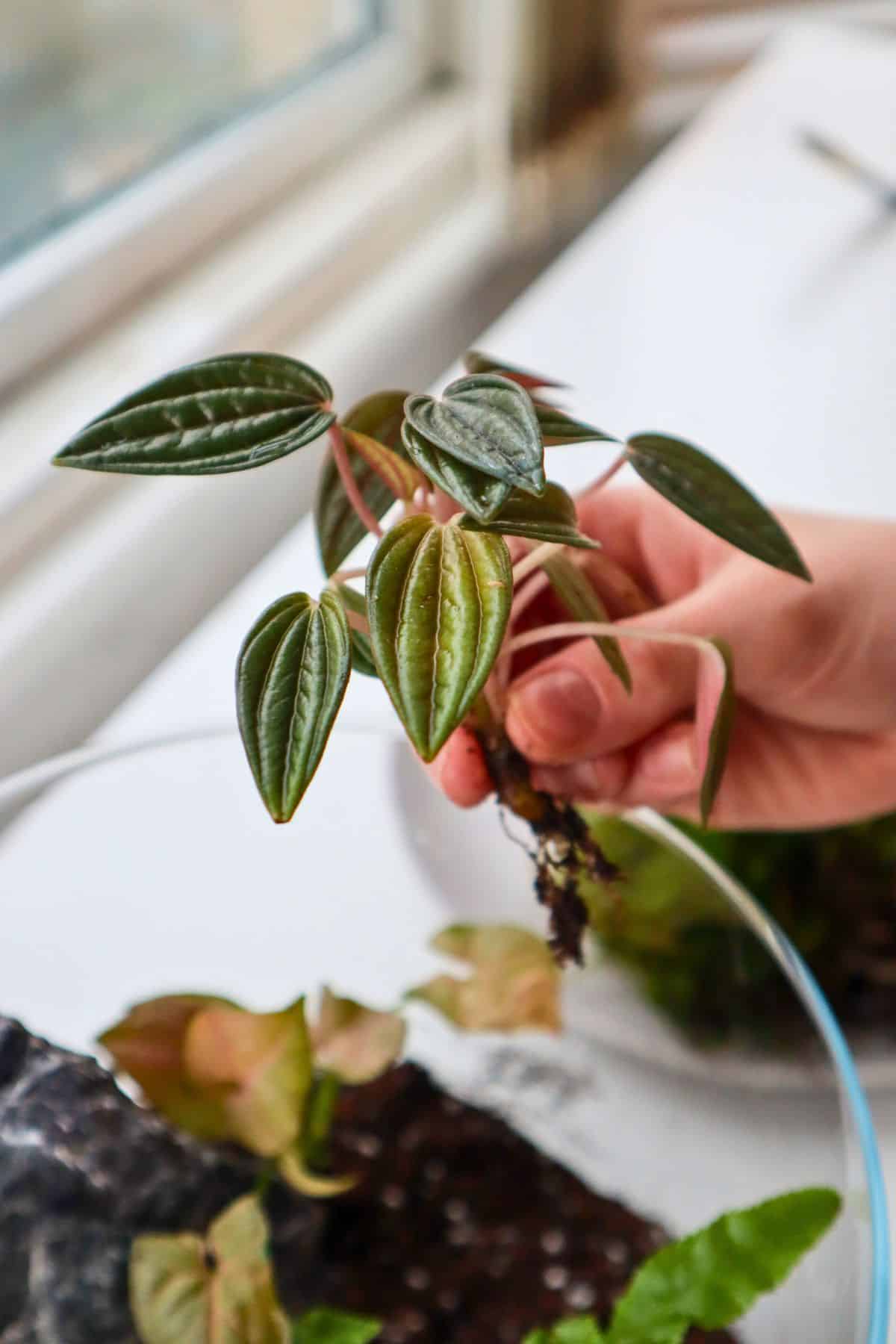
It stays small, grows slowly, and forms a compact rosette of dark green leaves with rich crimson undersides. That gives it a lot of visual impact without taking over the container.
That’s exactly what makes it useful in terrariums.
It works well as a small focal plant, especially in builds where you want something more structured than a creeping vine but less bulky than a classic statement plant. The leaves radiate from the center, so it has a neat, architectural quality without looking stiff.
The main thing to get right is moisture.
Peperomia Rosso is tropical, but it still has semi-succulent traits. It wants consistent light moisture, not a wet substrate. In a closed terrarium, that means watering carefully and making sure your mix has enough drainage and aeration.
2. String of Turtles
Verdict: A small, beautiful trailing Peperomia with a lot of versatility.
String of Turtles is probably the most famous Peperomia on this list, and for good reason.
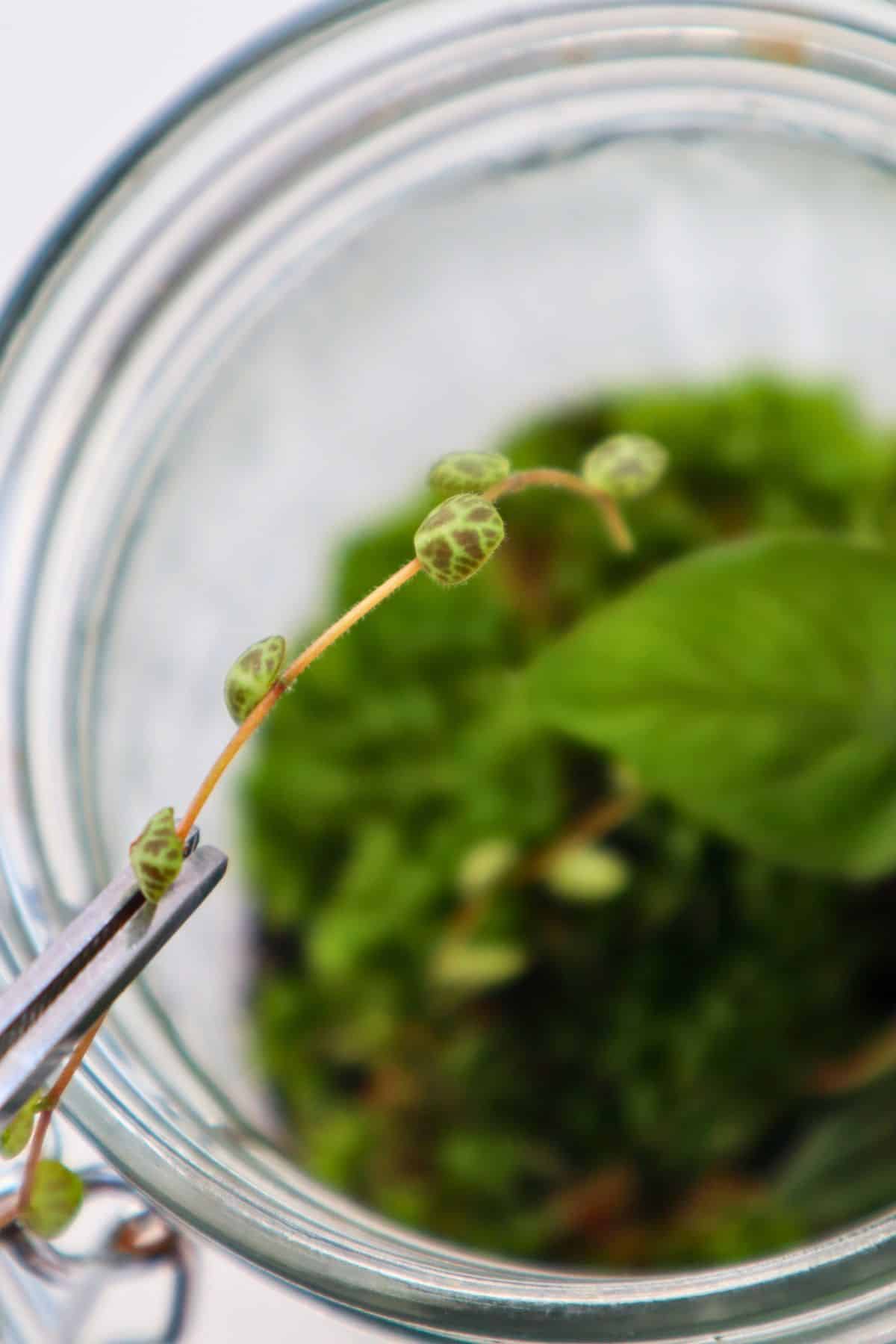
Peperomia prostrata has tiny, rounded leaves with markings that look like turtle shells. It’s cute, detailed, and almost unfairly good at making people buy it on sight.
The key is remembering that it’s both tropical and semi-succulent.
So it likes warmth and humidity, but it does not want to sit in wet substrate. Those thick leaves store water, and the roots are small and shallow, so it’s easy to overwater this one.
In a terrarium, you have two good options.
- You can plant it terrestrially in a very well-draining mix, keeping the substrate lightly moist rather than wet.
- Use it more epiphytically. Let it trail from hardscape, moss, or a higher planting point, where the vines can root into moist surfaces without sitting in a heavy substrate.
I find the latter is really where it shines.
A high placement can create a delicate cascade, and the patterned leaves bring detail to where you need it most.
It is not the fastest grower, so don’t expect instant coverage. Occasional trimming can encourage branching and help it fill out rather than becoming one long, lonely string
Trailing Jade Peperomia
Verdict: One of the best creeping Peperomia for terrariums.
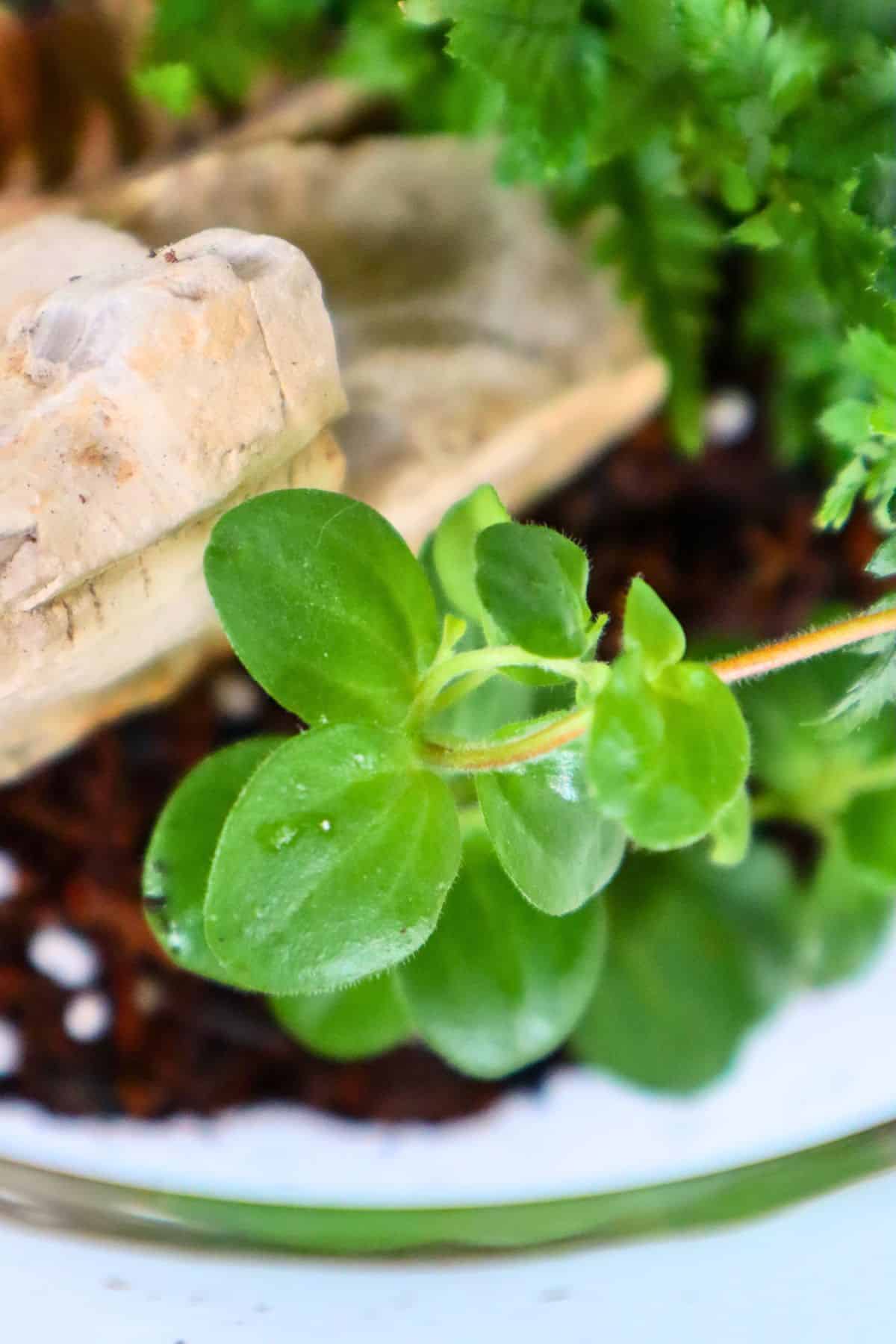
Peperomia rotundifolia, often sold as Trailing Jade or Creeping Buttons, is a fantastic terrarium plant when you want soft trailing growth without the chaos of a faster vine.
The small, round leaves have a plump, bright green look, and the stems can creep across the substrate, spill over hardscape, or soften the edge of a planting.
It’s especially useful when a terrarium needs movement.
Despite its reputation as a slower grower, Trailing Jade can thicken up quickly in terrariums (that extra humidity seems to suit it beautifully). Once it gets going, it can start trailing horizontally and filling the space in a really natural way.
String of Coins
Verdict: Another great terrarium trailer with more contrast than Trailing Jade.
Peperomia ‘Pepperspot’ is often mislabeled as Peperomia rotundifolia, but it’s actually much closer to String of Turtles. Think dark green coin-like leaves, pinkish-red vines, and a tendency to spill in every direction once it gets comfortable.

It works especially well across the floor of a terrarium, where the vines can creep through moss, around hardscape, or between larger plants. Once mature, it can also trail from higher planting points for a more cascading effect.
The color contrast is the real appeal. Those darker leaves and reddish stems give it more depth than many plain green trailers.
The best part is that Pepperspot also roots readily in a humid terrarium. You can place cuttings onto substrate, moss, or even a moist hardscape surface, and they’ll often root themselves into position over the following weeks.
Raindrop Peperomia
Verdict: A strong feature plant Peperomia, as long as the container has room for it.
Raindrop Peperomia is one of the bolder options for terrariums.
Peperomia polybotrya has thick, glossy, teardrop-shaped leaves that hold together in a relatively compact growth pattern. It doesn’t trail or creep likes others on this list. It sits there looking lush.

That makes it useful when you want a small feature plant with more presence than Rosso or Piccolo Banda.
The trade-off is space.
The Raindrop Peperomia is still compact compared with plenty of tropical houseplants, but it has larger leaves than most of the Peperomia on this list. In a small jar, it can quickly feel oversized. In a medium or larger terrarium, though, it works beautifully as a low-growing shrub.
Like other Peperomia, it may send up flower spikes, but they’re not exactly the main event. I’d usually pinch them off and let the plant focus on foliage instead
Peperomia Piccolo Banda
Verdict: Tiny, patterned, and almost tailor-made for terrariums.
Peperomia albovittata ‘Piccolo Banda’ is one of the easiest Peperomia to justify in a terrarium.
It stays compact, grows slowly, and has enough leaf patterning to earn its place without needing much space. The deep green, brown, or orange-toned veining gives it more character than a plain green filler plant, but it still behaves like a neat little terrarium citizen.
That’s the dream, really.
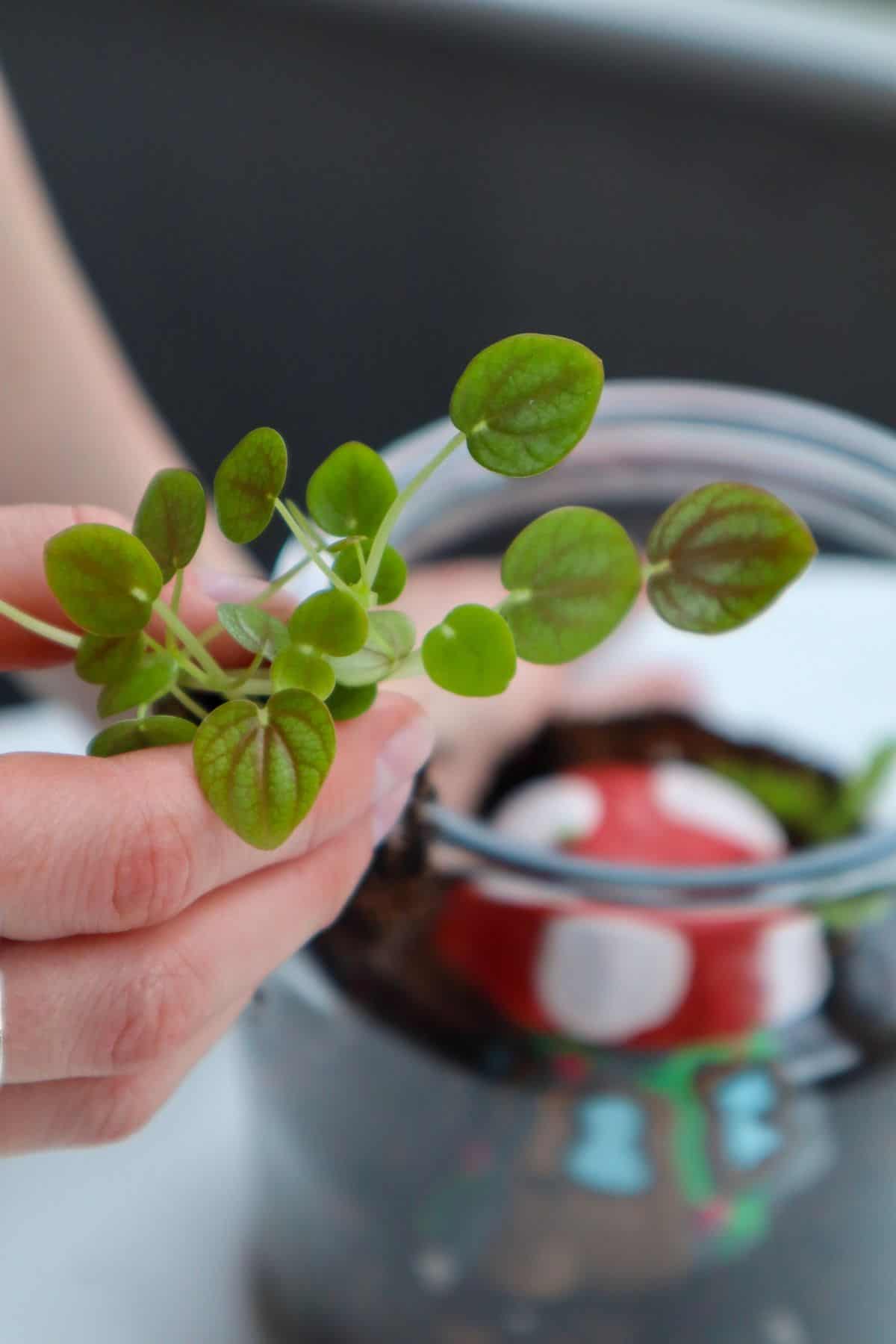
Piccolo Banda is also forgiving of humidity and temperature. It appreciates the higher humidity of a terrarium, but it doesn’t need everything to be dialed up to rainforest mode to survive.
It’s also naturally epiphytic, so a chunky, airy substrate mix makes sense.
Peperomia Hope
Verdict: A good pick for dryer setups.
Peperomia Hope is a lovely little hybrid with round, succulent leaves and a soft trailing habit once it gets going.
It looks like it should be one of the easiest terrarium choices. And in many ways, it is. It stays fairly compact and has that Peperomia toughness that makes it more forgiving than many delicate tropical plants.
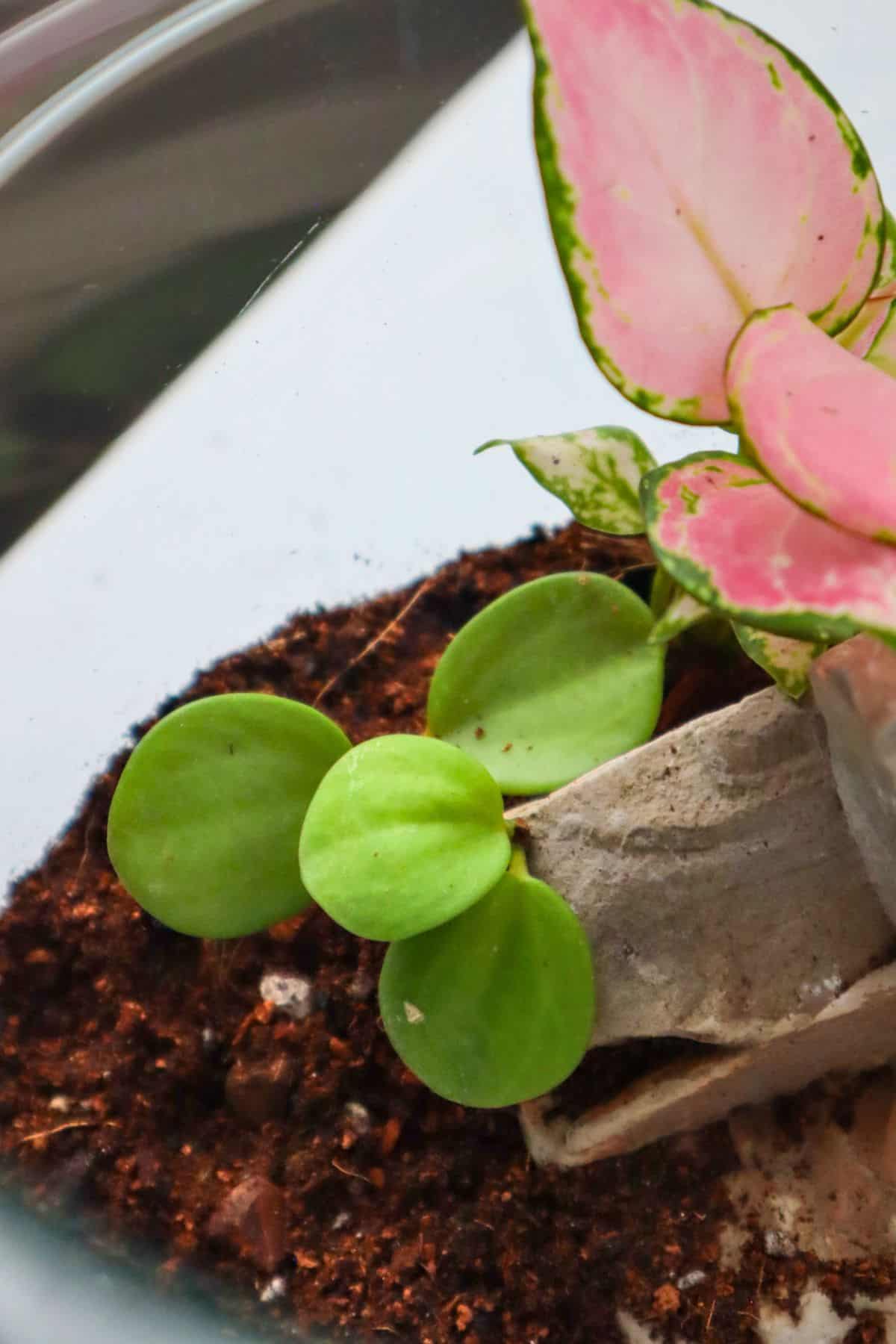
But it’s not quite as carefree as it looks.
The leaves store moisture well (arguably too well for a real tropical setup), and the root system is extremely shallow and delicate. That means drainage is everything. In a terrarium, if you plant it terrestrially, you need to be careful not to add too much water to the system.
Personally, I reserve this species for more open terrarium setups, or at least those with a partial seal.
Peperomia Hope also works well as an epiphyte. Mounting it on hardscape with a little sphagnum moss around the roots can be a better fit than burying it in substrate, especially if your terrarium runs on the wetter side.
Final Thoughts
Peperomia are some of the most useful small plants you can put in a tropical terrarium.
The trick is choosing the right growth habit for the space, rather than treating every Peperomia as interchangeable.
Give them bright indirect light, careful watering, and a light terrarium mix with enough air around the roots, and they usually behave beautifully.
Compact, colorful, easy to propagate, and generally well-mannered.
Which is more than can be said for plenty of terrarium plants.
