

In a bioactive terrarium, waste is unavoidable.
Leaves fall, roots die back, and decaying organic matter slowly builds up in warm, humid conditions. Left alone, that decay doesn’t just disappear – it accumulates, feeds mold, and starts to destabilise the system.
That’s where terrarium cleanup crews come in.
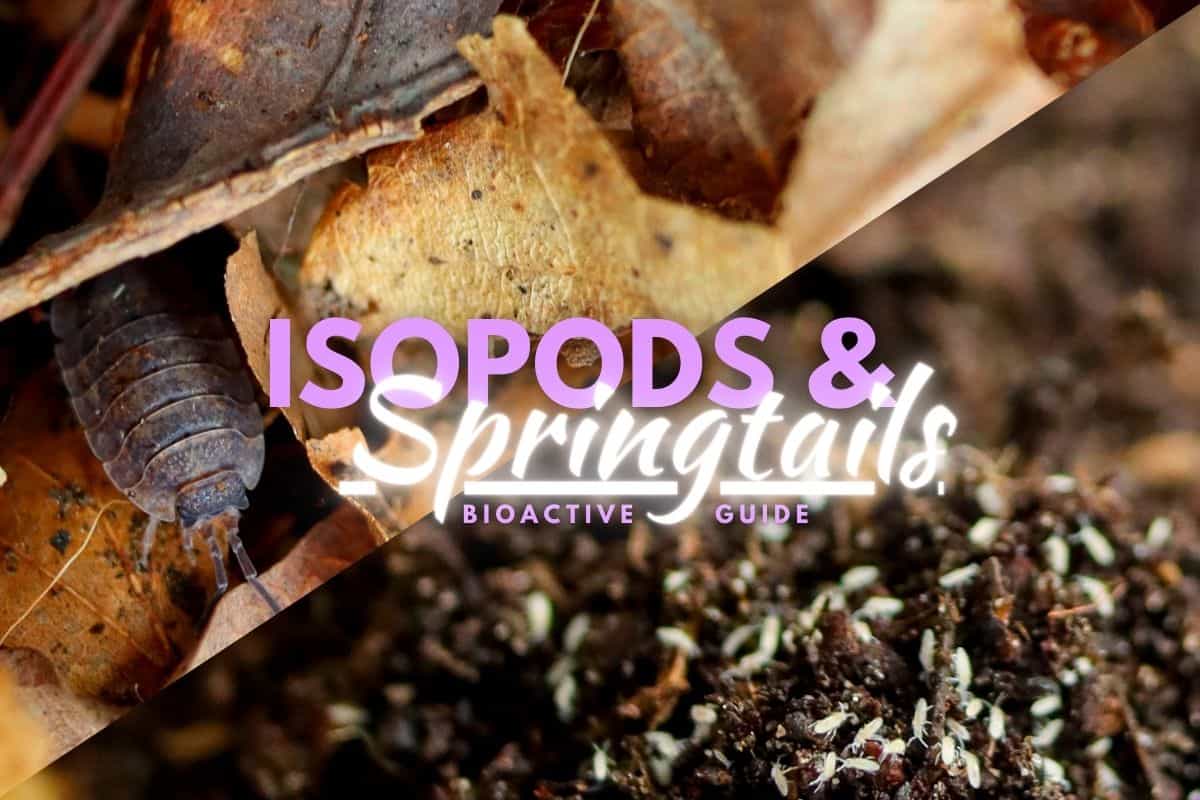
Isopods and springtails are common tag-team partners because they tackle different parts of the same problem. One works on the visible, structural mess; the other operates almost entirely out of sight.
Together, they help keep decomposition moving instead of piling up.
This guide explains how that partnership actually works in a bioactive terrarium – what each contributes, why they’re often paired, and when that combination makes sense (and when it doesn’t).
Why Cleanup Crews Matter in a Bioactive Terrarium
A cleanup crew isn’t about removing waste from a terrarium – it’s about processing it.
In natural ecosystems, dead plant material doesn’t magically vanish. It’s broken down gradually, moving through different stages of decay until its nutrients are returned to the soil.
A bioactive terrarium relies on that same process, just compressed into a much smaller, more controlled space. Without organisms to handle this work, organic material tends to linger, rot, and mold over.
Cleanup crews exist to keep that cycle moving.
They fragment and/or consume organic matter, regulate microbial growth, and prevent waste from bottlenecking at any single stage.
When they’re doing their job properly, decomposition stays steady, subtle, and (mostly) invisible.
The Role of Isopods: Macro Breakdown
Isopods handle the heavy lifting.
They feed on larger pieces of organic material like leaf litter, decaying wood, and fallen plant matter – the stuff that would otherwise sit on the surface or slowly rot in place.
By chewing and fragmenting this material, isopods increase its surface area, making it easier for microbes and other organisms to finish the job.
Anything they do consume themselves is released back into the substrate via their fertilizing poop (also known as “frass”). It’s a win-win situation.

What’s important to understand is that isopods don’t “clean” in the household sense. They don’t eliminate waste – they convert it into forms the rest of the system can use. Or at least into smaller forms that the next species can tackle.
On their own, though, they leave gaps. Finer decay and mold growth often occur at a scale they simply don’t interact with.
That’s where springtails come in.
The Role of Springtails: Micro-Level Control
Springtails work at a much finer scale.
Rather than breaking down visible debris, they operate in the thin layer where moisture, microbes, and decaying material overlap.
Their primary role is grazing – feeding on fungi, algae, bacteria, and biofilms that develop as organic matter begins to soften and break down.
This matters because those early microbial blooms are often what cause problems in terrariums.
Mold doesn’t usually appear because something is “wrong.” It appears because moisture and organic material have created ideal conditions for fungal growth. That’s somewhat unavoidable in a closed terrarium setup (mold spores are literally everywhere).

Springtails help regulate this phase of decay by continuously grazing across damp surfaces and substrate particles, preventing fungal populations from concentrating in any one spot. Growth stays thin, dispersed, and short-lived rather than dense and persistent.
(They’re also pretty good at out-competing any pesky mites and fungus gnats).
In a functioning cleanup crew, springtails act as the system’s fine control layer – keeping fungal and microbial activity in check while larger decomposers handle the bulk of the work.
When You Actually Need Both (& When You Don’t)
Using isopods and springtails together isn’t always necessary.
It depends on what kind of terrarium you’re building and how much organic turnover the system has to handle.
In a fully bioactive terrarium, where plant matter is constantly growing, shedding, and breaking down, the pairing makes the most sense. Larger debris accumulates (especially in the case of animal vivariums), and you need both species to tackle the problem effectively.
That said, in simpler, smaller, plant terrariums, springtails can often do the job alone.
You can always help them out by removing fallen leaves and such. In these setups, mold is usually the main issue worth managing.
Care requirements matter too. Springtails are largely self-sustaining once established, while isopods require more attention – feeding, ventilation, and population monitoring all become part of the equation.
The takeaway isn’t that every terrarium needs a highly-optimised cleanup crew, it’s that cleanup crews should match the workload of the system.
Common Cleanup Crew Mistakes
Most cleanup crew problems don’t come from choosing the “wrong” species (though sometimes that’s the case), they typically come from mismatched expectations.
1. Adding an Isopod Culture Too Early
A brand-new terrarium often doesn’t produce enough waste to support an isopod culture straight away. Even leaf litter provided for isopods needs time to decompose.
Without decaying matter, isopods are left competing for scarce resources.
This usually leads to populations stalling or crashing – not because conditions are bad, but because there simply isn’t enough work for them to do yet.
If you do want to add them right away (which makes sense, it’s the most convenient time) you can supplement their diet with food scraps or our Superfood Powder.
2. Expecting Springtails to Fix Moldy Terrariums
Springtails are much more effective at keeping mold in check than they are at tackling mold overgrowth.
If your terrarium is already looking like a spider’s web, it’s too big a task for a fresh culture of springtails…
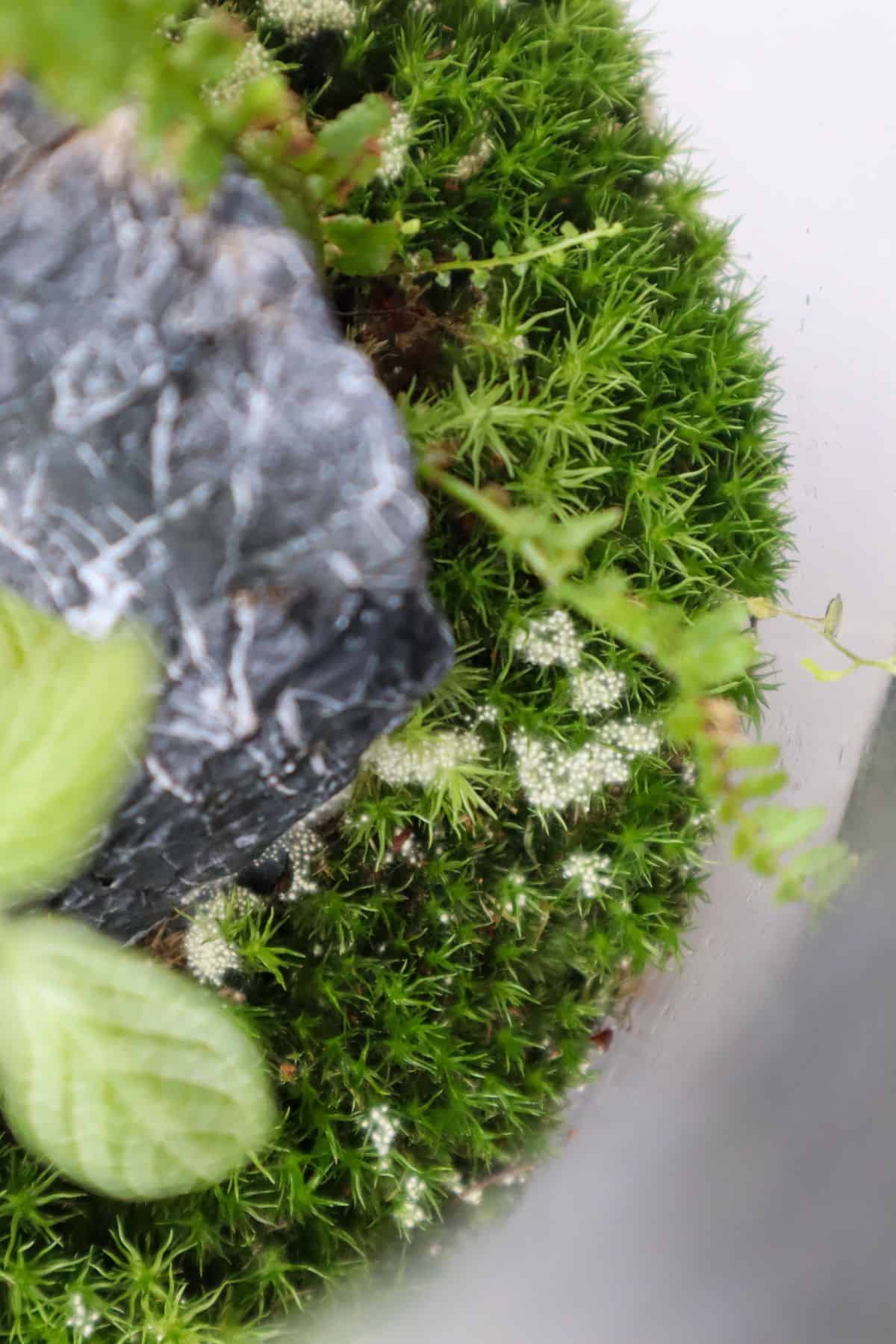
Unlike isopods, I think there’s no problem adding springtails right away. There’s always a mold spore or thin biofilm developing somewhere for them to eat.
3. Overloading Small Terrariums
More organisms doesn’t mean better cleanup.
In small containers, adding too many isopods can lead to overgrazing, rapid waste buildup from the crew itself, and increased maintenance rather than less. Springtails are more forgiving at higher densities, but even they need limits.
Cleanup crews should scale with the volume and output of the system, not enthusiasm.
We recommend at least a 3-gallon terrarium container for one of our standard 10-count cultures.
Going Deeper Into Species Choice
This guide focuses on how cleanup crews function as a system. If you’re ready to look at species selection, care requirements, or population management in more detail, these guides break that down further:
- A deeper look at how different isopods behave and contribute in terrariums
- A focused guide on springtails in terrariums, including care, culturing, and mold control
Think of this page as the why behind the pairing – those guides cover the how once you’re ready to choose.

Very interesting article. A few years ago, I added some tropical plants in my Exo-Terra. Then, I addd some dead leaves from a forest near where I live. After a few days, I noticed babies isopods. They grew fast and reproduced very well. I feed them with salad and vegetables. After a few months, I must had near one hundred of those isopods.
Now, my terrarium is empty. I want to create an habitat for epiphytic plants. I plan also to introduce tropical isopods and try springtails.
Continue your good work. I really like your articles.
Thanks for the kind words Stephan! 🙏
I guess with my terrarium it’s not always closed down. Have a partial lid w/ a plant grow light meant for an aquarium…Yescom75.
My question is, will they crawl out (up the glass and out)
Thanks! Thomas
Springtails can jump and isopods can climb – so there’s nothing stopping them from making their way out of the opening if it’s large!
Very helpful Dude!
Hello and thanks for all your info and enthusiasm. How do you work out how many spring tails and isopods you would add for the size of a given terrarium?
Thanks, Rob
Hey Rob, to be honest, I find it quite challenging to calculate how many you’d need to fill a terrarium (there are so many factors to consider). It’s so much easier to just buy a starter culture of each and allow them to reach their own natural population density in the space.
New to all of this, what keeps these useful guys from getting out of the substrate and spreading around your living space? Are they going to stay where I put them in the ecosystem they are intended?
A lid hopefully 😂
Silly question, but what do I do when the springtails and isopods pass away? Not abnormally, but just a normal life cycle. Do I pick them out or do their deceased selves add to the mini ecosystem?
It’s a very good question – not silly at all! Turns out, they’re quite the nutritious snack for their living friends as gross as it sounds 😂
Hi! Thanks for the awesome article. I was recently inspired to make my own terrarium, and have a few questions, but I won’t bother you with all of them. I’m just wondering; Can I have Millipedes or small snails in my Humid Swamp Terrarium ? The thing is, I definitely plan on having isopods and springtails, but I’m just curious if millipedes and/or snails could help clean the ecosystem, or be overkill, since this combo works so well. Also, will springtails or isopods be eaten by American Toads?
Thanks so much, Gabe
Hi Gabe, I’m afraid American Toads don’t fall into our remit! But you might like to check out our article on millipedes in terrariums, and our article on snails in terrariums.
Hi! Thank you for the awesome article. I just received my isopods and springtails! But now I don’t know what to do with them to keep them from dying. Do I have to use them right away or can I use them when I am ready to build my terrarium? Thank you!!
Hi Olivia, they’ll likely be fine in the container/substrate they arrived in for a short while but I’d aim to put them in a suitable culture box or terrarium as soon as you reasonably can.
I’ve added springtails & isopods to my terrarium. I can usually find a couple of the isopods crawling around, but I can’t see any of the springtails. Do I just give it time & how much time? The mold is getting pretty intense, so if I need to add more, I’d rather do it before it’s too late to save my terrarium.
Hi Sarah. A springtail population will grow if there’s more food (mold) available, so you shouldn’t need to add more. A mold bloom is relatively normal and often goes away on its own in time.
Hi guys! I received my springtails, they arrived alive and well! They came in a brown “mud” like substrate. I wasn’t sure how to transport them into the terrarium so I just scooped it out and put it directly into the terrarium, but now I’m wondering if that’s going to harm them?
Hi Kate! The mud-like susbstance is calcium-bearing clay. You don’t need to add that to the terrarium, it’s just a medium to culture them on. You can simply tap (or wash) your springtails out of the cup and into your terrarium. Though it won’t do them any harm in the terrarium, I’d probably remove the clay if you can.