

Terrariums sit at a rare intersection of science and horticulture.
At their heart, they’re miniature ecosystems – sealed environments where water, carbon, and nutrients are constantly moving between plants, soil, and air. When those processes fall into balance, a terrarium can quietly look after itself for years with very little input.
The tricky part is that it’s easy to oversimplify what’s really going on.
A lot of explanations stop at “it recycles water” or “plants clean the air,” without digging into how those processes actually interact – or why small setup mistakes can slowly throw the whole system off.
In this guide, we’ll break down how terrariums really work, using the science that underpins them. We’ll look at the key natural cycles involved and what happens to them once they’re squeezed into a glass container on your shelf.
So, how do terrariums work? Let’s take a closer look.
How a Terrarium Works as a Self-Contained System
The core concept of what makes a terrarium work is its own personal microclimate.
Sealed up tight in a container, your terrarium even has its own weather! (Of sorts).
That’s why a balanced closed terrarium can drive the same natural processes that drive the Earth. Namely, the Water Cycle and the Carbon Cycle.
Just on a much smaller scale… and somewhat simplified.
Photosynthesis, respiration, decomposition, and nutrient cycling – they all play out in terrariums, too.
These natural mechanisms work in harmony to keep our plants nourished and healthy. So, if we know how these play out on a wider scientific level, then it helps us understand how a closed terrarium system can sustain life (and how to apply them to a project).
So, in the rest of this guide, we’re going to deep dive into each of these cycles, and then we’ll later pull it all together to see how a complete terrarium ecosystem works.
Understanding the Water Cycle in a Terrarium
On our planet, the Water Cycle describes the many ways that water moves through the ocean, land, and atmosphere. An endless loop of water collection, relocation, and redistribution.
In short, this can be summed up into these three key steps.
- Water evaporates from the surface to become water vapor in the atmosphere.
- Water vapor cools and condenses to form clouds.
- Water then returns to the Earth in the form of precipitation.
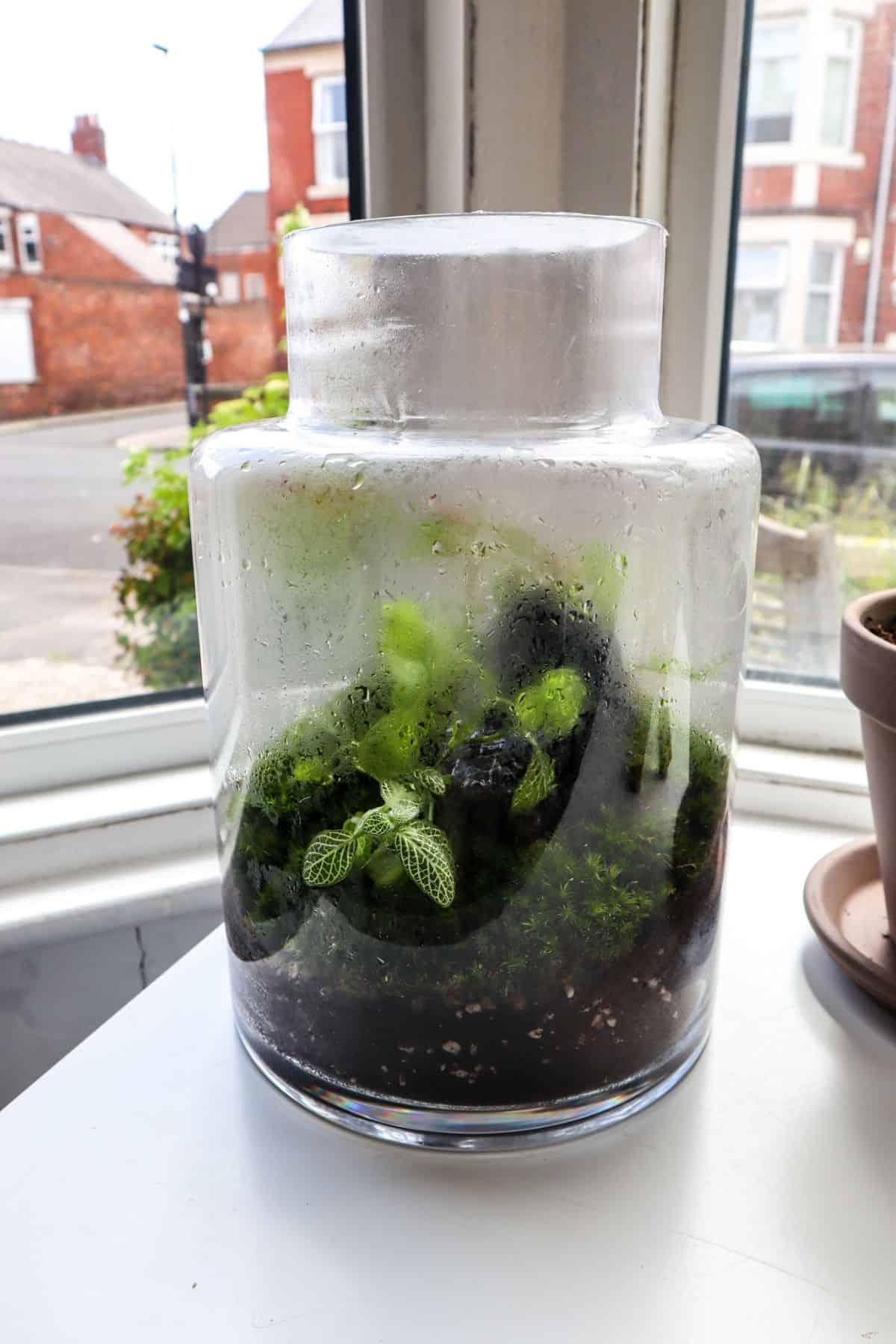
Of course, the full process has many smaller steps and nuances (depending on the environment). But when it comes to terrariums, the process is much simpler.
There’s only one focus that really matters, and that’s plants.
Plants are the primary drivers and recipients of the terrarium water cycle. They take water in via their roots and later release it through their leaves in a process known as transpiration. That’s what keeps the cycle moving.
Transpiration is the movement of water from the soil through a plant (via roots and tissues) and out of the leaves into the atmosphere.
So, where does this water cycle begin in a terrarium?
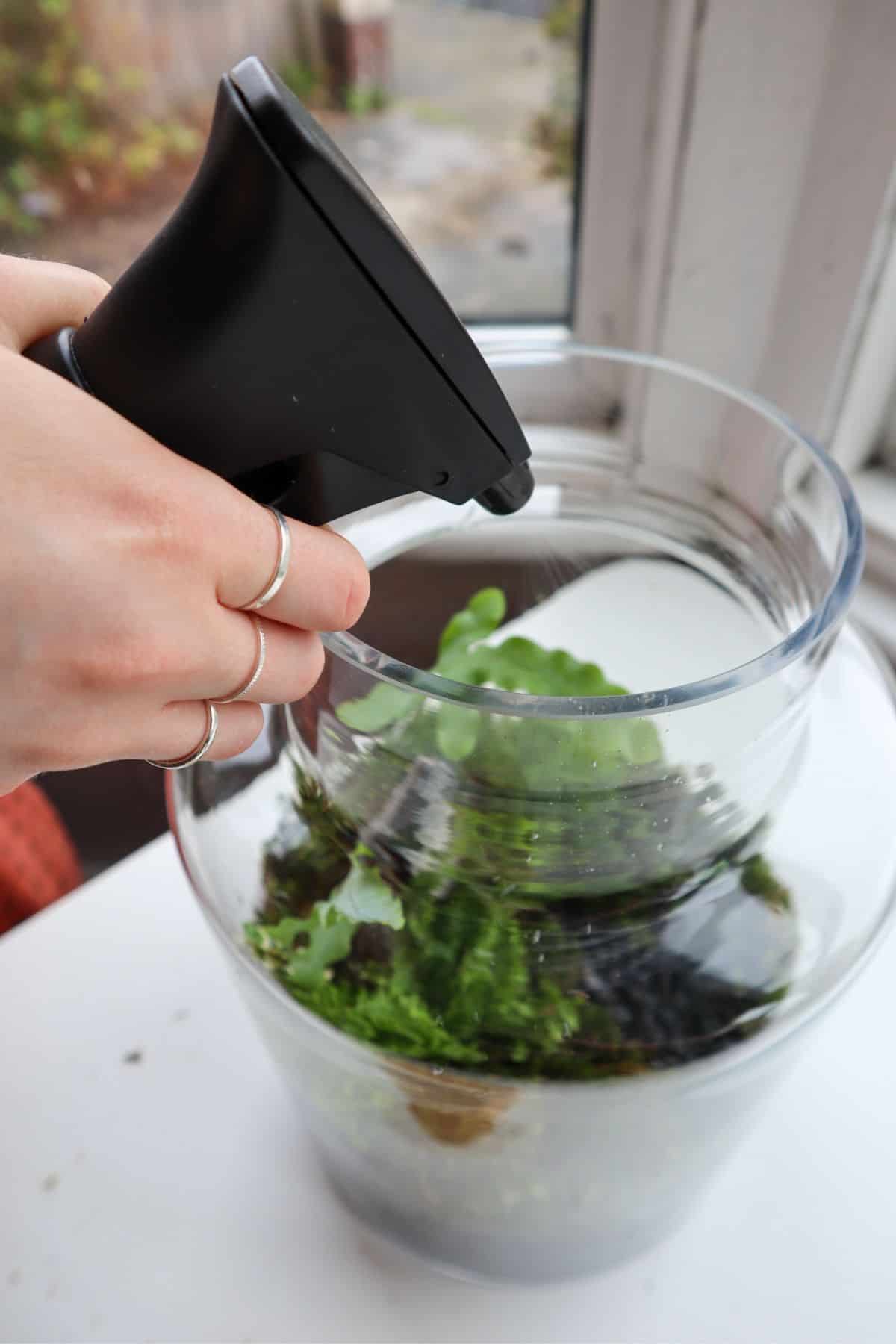
- We add water by spraying the terrarium, and the precipitation drips down into the substrate (just like rainfall) and coats the inner surfaces of the terrarium.
- Here, the plants’ roots can absorb the water, taking it up into the plant tissues. Eventually, that water is released through their stomata as part of their transpiration cycle.
- When the environment warms up, the surface water (from the leaves and glass) evaporates to become water vapor in the air.
- Later, when the environment cools down, water condenses on the inside of the cool glass surfaces.
- Finally, that water drips down into the substrate as precipitation once more – beginning the cycle again.
See the similarities with our own world?
In a completely sealed environment, there should be no water loss. So once you have the perfect amount to balance the system, you can stop there.
The Carbon Cycle in Terrariums
The Carbon Cycle follows the movement of carbon atoms through the Earth’s natural processes.
It’s present in everything from the cells in our bodies to the very air that we breathe. So, thankfully, once again, we’re narrowing our focus to just plants and terrariums here.
So, in practice, the “Terrarium Carbon Cycle” is much easier to understand.
It’s essentially the movement of carbon from the terrarium environment (the atmosphere and the soil) into the plant – and back again.
Simple right?
Let’s break that down into two key processes.
Atmospheric Carbon Cycles – Photosynthesis and Respiration
Okay, seeing as carbon is already present in the air we breathe – in the form of atmospheric carbon dioxide – we can be sure it’s already present in our terrariums when we seal them up.
So, the first step in the cycle is arguably the one that draws atmospheric carbon into the plant.
That’s why photosynthesis could be considered the biological driving force behind the plant aspect of the Carbon Cycle.
Photosynthesis is the process where plants combine sunlight energy and CO2 to produce oxygen and glucose.

So we can see now how plants utilize carbon to fuel themselves, but that doesn’t answer the question of how the plants get a consistent supply of fresh CO2 in a sealed container.
If plants need carbon dioxide to produce energy, that would seemingly eventually run out in a sealed container, wouldn’t it?
Thankfully, our plants are sealed in there with something else – bacteria!
Just like in nature, there are billions and billions of bacteria in the soil. These are all undergoing cellular respiration – using oxygen to break down glucose (to energy in the form of ATP) and producing CO2 in the process.
Plants actually do this, too, just on a much smaller scale.1

So you can see, in a well-balanced terrarium, there is an equilibrium between plant transpiration and (mostly) microbial respiration.
Decomposition Carbon Cycles – The Nutrient Cycle
The other part of the equation is how those solid biological carbons (the ones locked up in plant tissues) return to the environment. This is a cycle, after all.
Naturally, when plants drop leaves or perish entirely, those plant tissue carbons need to be broken down and extracted before they can move on and be reused elsewhere.
On our planet, this is the Decomposition Carbon Cycle – and it’s driven by two key players.
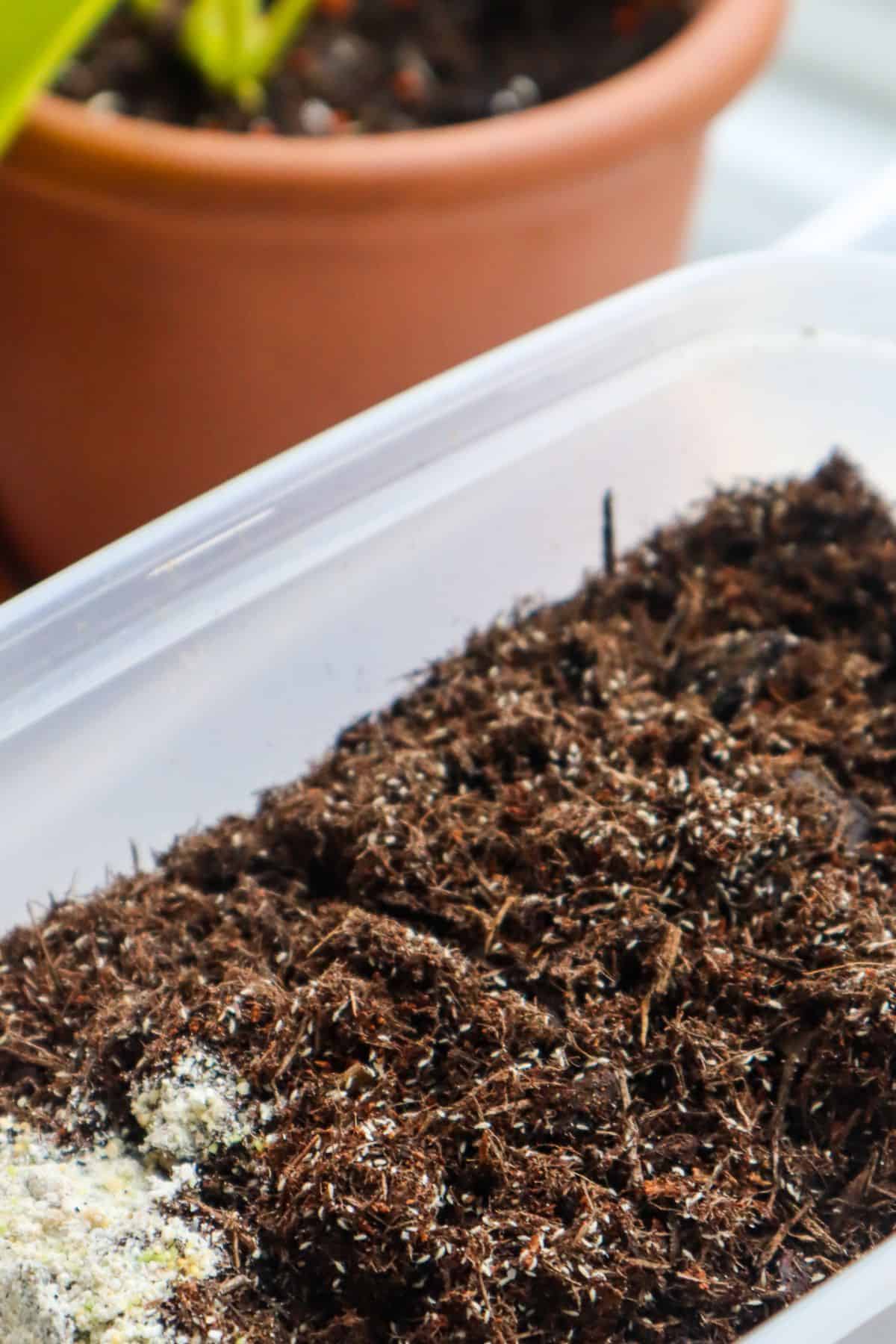
- Microflora – Bacteria and fungi in the soil are responsible for most of the heavy lifting and actual decomposition work.
- Microfauna – Tiny bugs and insects that help the process along by feeding on decomposing material and breaking it down into simpler compounds. Think isopods, springtails, and worms, to name just a few!
In a terrarium, it’s exactly the same!
Well, most likely a much more simplified version (it’s near impossible to fully replicate a natural ecosystem of decomposers), but the effect is the same.
A terrarium that utilizes microfauna and microflora to drive the nutrient cycle is called a bioactive terrarium setup.
The Full Closed Terrarium Ecosystem
Now, do you want to know how to make a terrarium ecosystem that can fully sustain itself?
You’ll need to put everything above into practice (and hope for the best).
In essence, this means balancing:
- Moisture levels. So that there’s enough to drive the water cycle but not so much that your plants rot (adding too much water is a quick way to end a terrarium).
- Light levels. So your plants get plenty of energy for photosynthesis, but not so much that the Sun burns their delicate leaves.
- Bioactivity. So that carbon can be effectively recycled from the atmosphere and the plant matter. You need enough microflora and microfauna, but only enough that your terrarium can support.
- Plants. So that there is sufficient plant biomass to fuel the whole process.
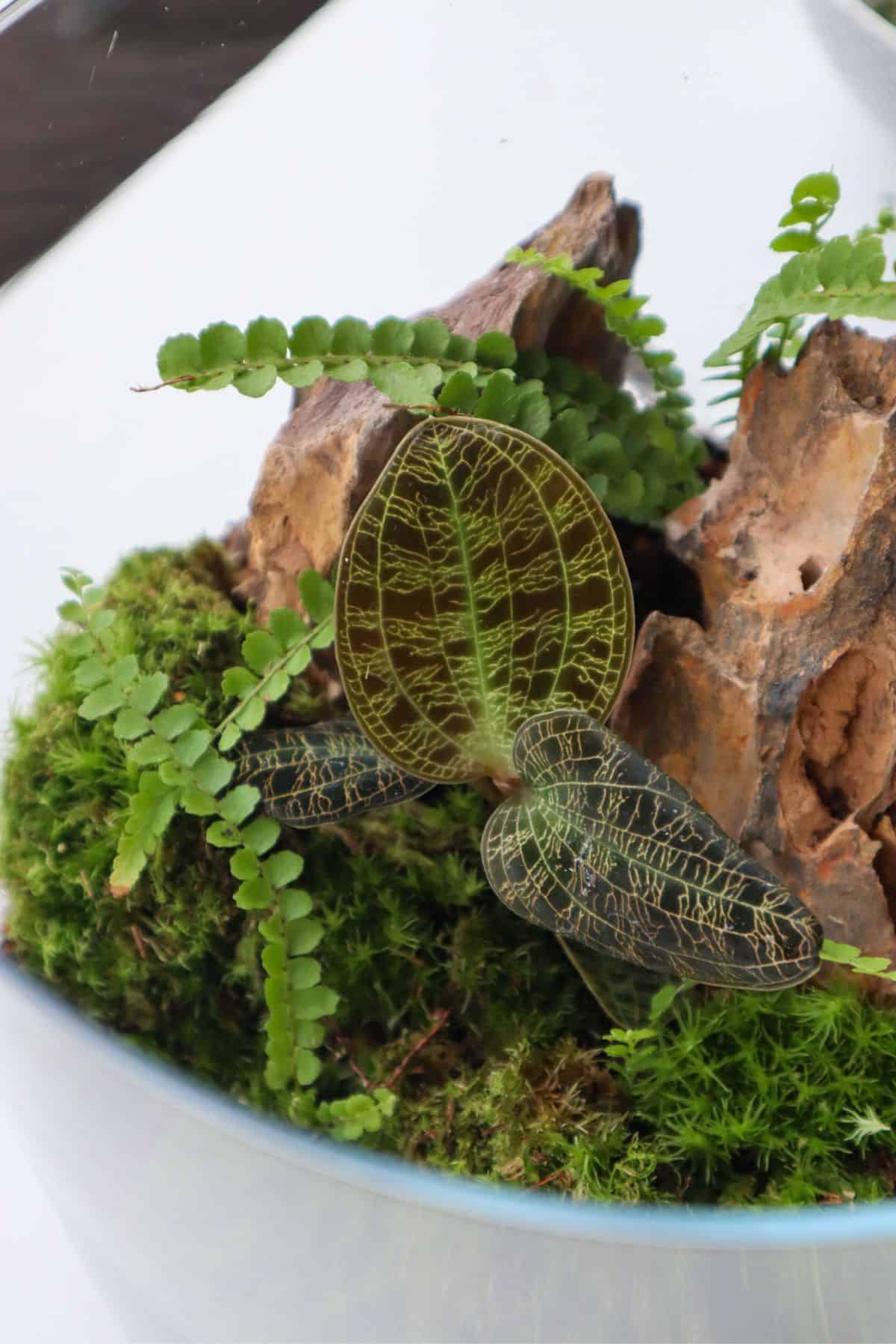
All of this is easier said than done. After all, natural ecosystems have built-in buffers for when things go wrong, whereas a terrarium ecosystem is a lot more fragile.
With all of this in mind, it’s easy to get the feeling that we need to get everything perfect for it to work.
However, terrarium-making is not an exact science.
Unlike a food recipe, there is no formula for guaranteed success. Sure, it’d be nice if it were as simple as “Mix one cup of plants + one jug of water and whisk thoroughly till you have an even horticultural batter.”
Alas, the perfect “terrarium cake” recipe is different every time…
Every terrarium has its own unique ingredients, environment, and care requirements. So it’s up to you to figure out how to make it work.
How Long Do Terrariums Last?
If you’ve managed to balance every cycle perfectly, you could theoretically have a terrarium that lasts indefinitely.
The oldest closed terrarium is reportedly over 50 years old (as demonstrated by David Latimer).
I’ve also spoken to several people who’ve reached out looking for advice on similarly aged terrariums, so it’s certainly possible. The key really does seem to be just leaving them alone!
All that said, perfectly balanced terrariums don’t really exist.
The super-old terrarium ecosystems tend not be the healthiest or the prettiest, so the idea of an “eternal terrarium” that you never open isn’t necessarily a goal to aim for.
A well-maintained terrarium (with a bit of luck) can absolutely last for many years, too.
If you’re curious how that balance plays out in the real world (and what “success” actually looks like over months or years), I’ve broken that down in more detail here: How Long Do Terrariums Last?
So… How Do You Make a Terrarium That Actually Works?
If there’s one takeaway from all of this, it’s that terrariums don’t succeed because of a single trick or ingredient.
They work when the core cycles – water, carbon, nutrients, and light – are allowed to balance naturally within a confined space. Once those processes are in sync, the system does most of the work for you.
That’s also why there’s no universal formula for success. Every terrarium is a little different, and long-term stability depends on how well those internal processes settle over time.
References
- https://www.britannica.com/story/do-plants-emit-oxygen-and-carbon-dioxide-at-night ↩︎

Hi Dan, Rae and everyone.
I’ve just bought myself a large green bottle terrarium (currently empty) as I’ve been interested in them for a while.
I have plenty to learn and I fell like I’m going to enjoy delving into something new and creating something I can love and care for, or just observe.
Quite excited! 😬
Best wishes, Dan.
Thank you, Dan – this looks properly authortitative (I have read so much cr*p on this topic before getting here). I think the key point is that, while plants do release some CO2 during the night, they need the cellular respirration (whatever that is!) of bacteria to do most of the CO2 generation needed to keep the atmosphere in balance.