

Many popular indoor ferns will grow incredibly well in a terrarium.
They’re a natural fit for the environment, but the real problem is actually making them fit in the container. Most common house ferns rarely stay small.
Thankfully, there are some genuinely solid options, and with some creative dividing and trimming, you can make a lot of the others work.
And some are just best avoided.
So this guide looks at familiar fern species through a terrarium lens. I’ll break down the most common indoor ferns grown as houseplants, and give my verdict on whether they’re good for terrariums.
1. Asparagus Fern
Verdict: Works well, but it’s not really a fern – and it knows how to make a mess.
Despite the name, it’s technically neither a fern nor a vegetable. It is, however, a genuinely useful terrarium plant when used carefully.
Asparagus setaceus has bright green, triangular, needle-like foliage that brings a completely different texture to a planted build. I like it most as a contrast plant, especially alongside broader-leaved tropicals and true ferns. It adds a light, feathery look without feeling heavy.
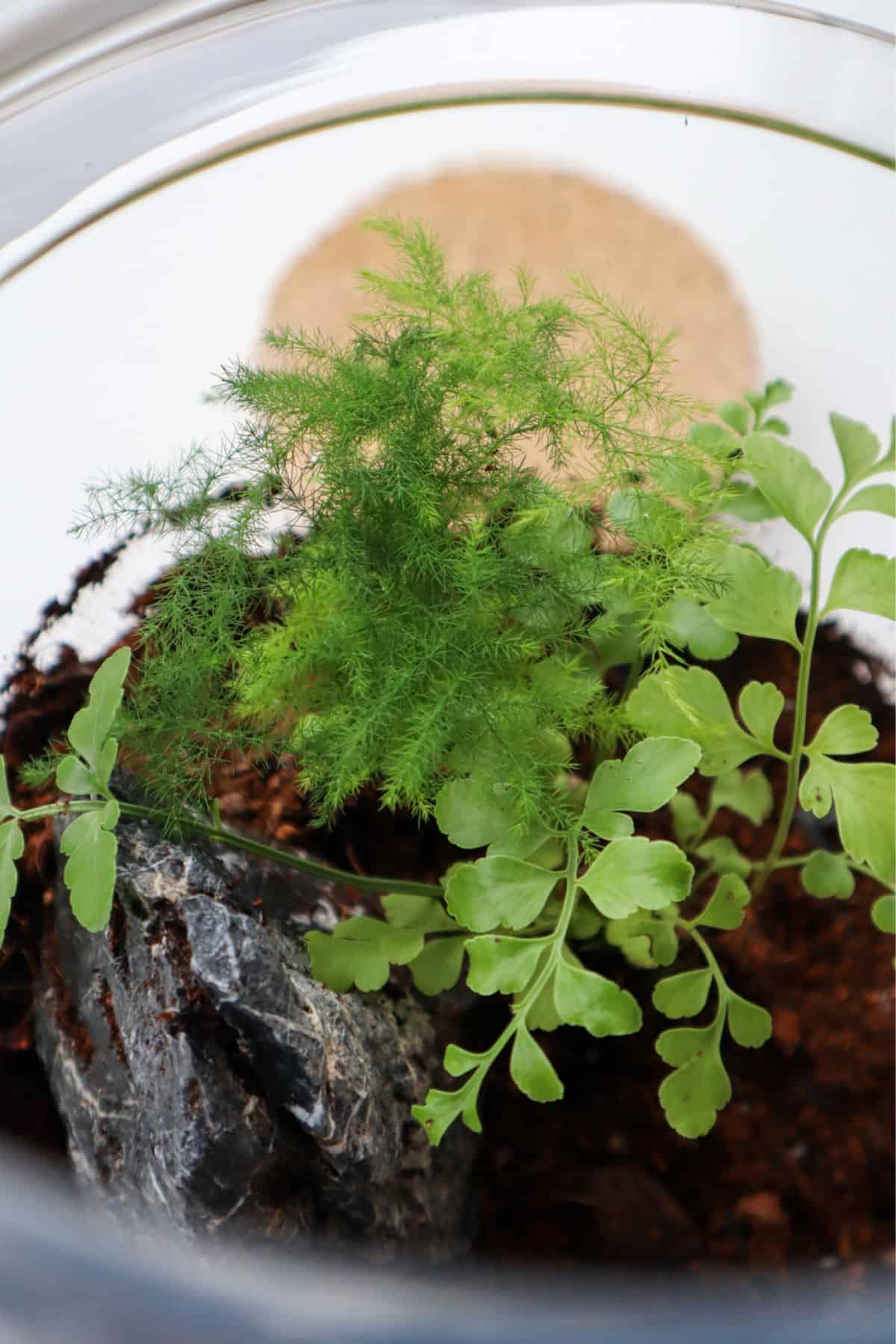
The real issue with this plant is growth.
Asparagus Ferns can get big. Really big. In the home, they can eventually reach several feet high and wide, and they grow reasonably fast when happy.
In a terrarium, that means they’re best used as small divisions rather than full plants.
(They also develop thick, tuberous roots, which can become a problem in enclosed glass long before the foliage does).
The other issue is leaf drop. Those tiny green needles shed everywhere, and removing them from a terrarium with tweezers is nobody’s idea of a good afternoon.
Dropped foliage can end up rotting if it builds up, so this is one fern-ish plant I’d strongly prefer in a bioactive terrarium with springtails and isopods to help process the mess.
2. Delta Maidenhair Fern
Verdict: Beautiful, highly suitable, and absolutely capable of emotional damage.
The Delta Maidenhair Fern is one of the most elegant ferns you can put in a terrarium.
Adiantum raddianum brings a soft, frilly texture on dark, delicate stems. It has that airy, woodland quality that can make a terrarium feel instantly more natural and mature.
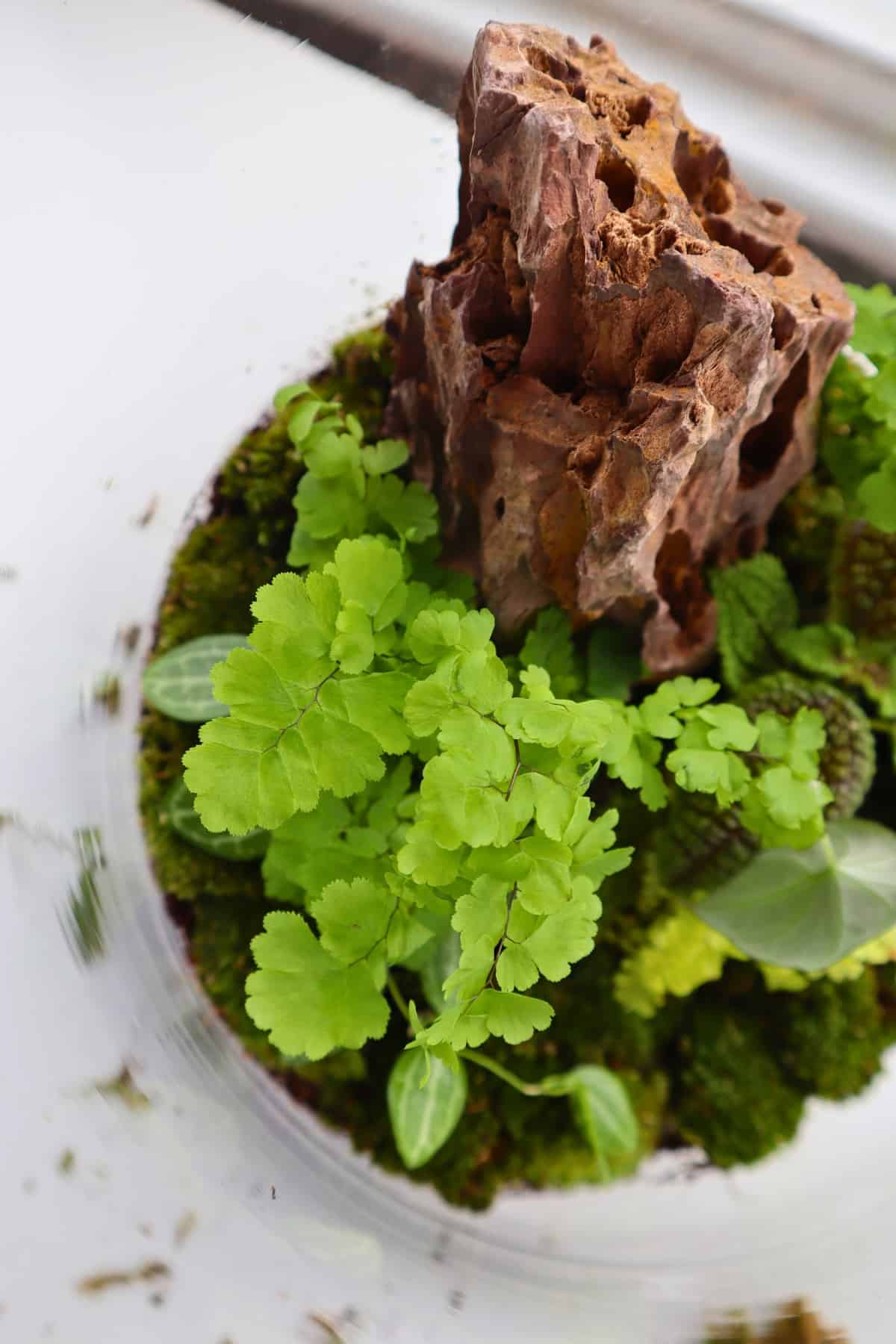
It also genuinely benefits from terrarium conditions. Maidenhair Ferns are famously thirsty and deeply offended by drying out. In a normal pot, that can make them difficult. In a closed terrarium, the stable humidity and consistent moisture can work strongly in your favor.
This is one of those cases where the terrarium solves a real houseplant problem.
That said, it doesn’t become bulletproof. Maidenhair Ferns are infamously fussy, and a terrarium doesn’t change that.
They also dislike being handled. The fronds are delicate, and the foliage can react badly to oils from your fingers. Once it’s planted, try to leave it alone to do its thing.
In terms of size, Delta Maidenhair can reach around a foot or more, but it tends to grow slowly and can be managed reasonably well in the right container.
It’s not the easiest fern on this list, but it is one of the most rewarding.
3. Blue Star Fern
Verdict: Gorgeous, forgiving, and best treated as a statement fern.
The Blue Star Fern is not a subtle plant.
Phlebodium aureum has broad, fanned-out fronds with a blue-green tone that immediately stands apart from standard fern foliage. If you want a fern that brings color as well as texture, this is one of the more interesting options.
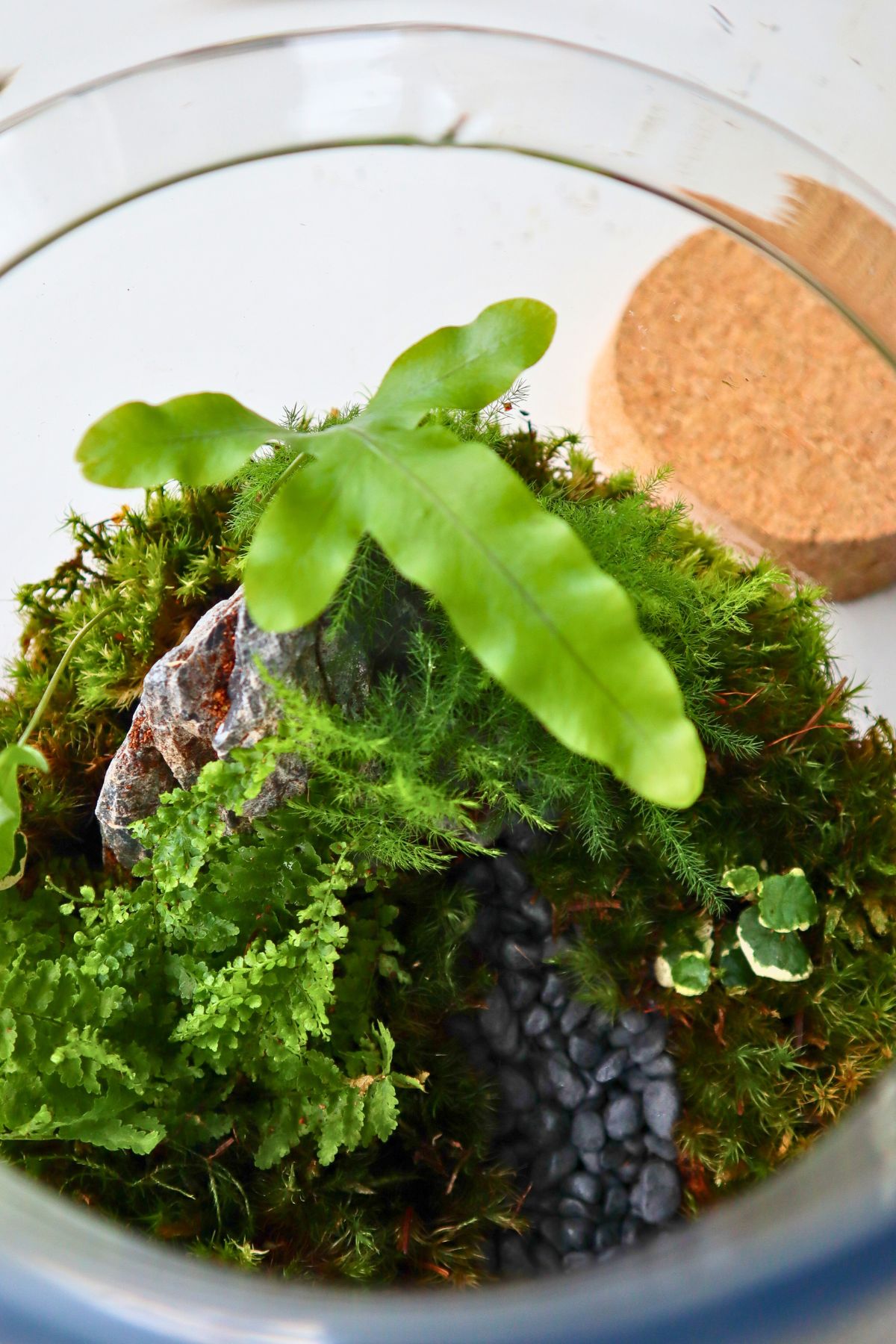
It also adapts well to terrarium conditions. As an epiphyte, it appreciates humidity, bright indirect light, and a loose, airy substrate.
So, as with many epiphytic ferns, drainage and aeration matter.
The other major factor is size. Blue Star Ferns can become large, and in the wild, they can become absolutely ridiculous. Indoors, and especially in terrariums, they’re usually more restrained – but they can still outgrow a small setup.
I’d use this fern where you want it to be a focal plant, not as a polite little background texture.
It grows from a rhizome and can become bushier over time. Smaller divisions are much easier to use in terrarium builds than full nursery plants.
4. Rabbit’s Foot Fern
Verdict: Excellent character plant, especially when you let the rhizomes do their thing.
Rabbit’s Foot Ferns are named for their fuzzy, creeping rhizomes, which spill over pots and surfaces like little plant paws.
Yes, it’s weird. Yes, it’s charming.
Davallia fejeensis is versatile in terrariums because it can be grown terrestrially in the substrate or mounted epiphytically onto wood or rock.
The plant itself likes bright indirect light, regular moisture, and high humidity. In a closed terrarium, it has no problem getting the humidity it wants. The real question is whether the container gives it enough space.
Those fuzzy rhizomes are part of the appeal, but they also want to creep.
In a small terrarium, it can become cramped quickly. In larger builds, though, Rabbit’s Foot Fern can look fantastic spilling over hardscape or softening the base of a planting.
It’s also easy to propagate by division or rhizome cuttings, which makes it easy to create appropriately sized pieces for terrarium work.
5. Crocodile Fern
Verdict: Brilliant in large terrariums, too bold for tiny jars.
The Crocodile Fern is one of the most distinctive ferns you can use in a terrarium.
Microsorum musifolium has broad, strap-like leaves with dark green, scale-like venation. It looks tropical, textured, and slightly prehistoric – which is exactly the point.

It’s a strong terrarium plant in the right setup. It loves warmth, humidity, and consistent moisture, and it can look incredible in a larger tropical build.
But this is not a delicate filler fern.
Crocodile Ferns can get big. Indoors, they usually stay much more manageable than they would in the wild, but even then, the foliage is broad enough to visually dominate a small container.
It works best in larger jars, demijohns, and tank-style terrariums where the leaves have space to unfurl properly.
Like other Microsorum ferns, it has epiphytic tendencies and shallow roots, so substrate quality matters. You want moisture retention, but you also need drainage and aeration. A dense, soggy mix will not do it any favors.
It’s fairly slow-growing, which helps, but I’d still treat it as a feature plant rather than background greenery.
6. Korean Rock Fern
Verdict: One of the most terrarium-friendly ferns on this list.
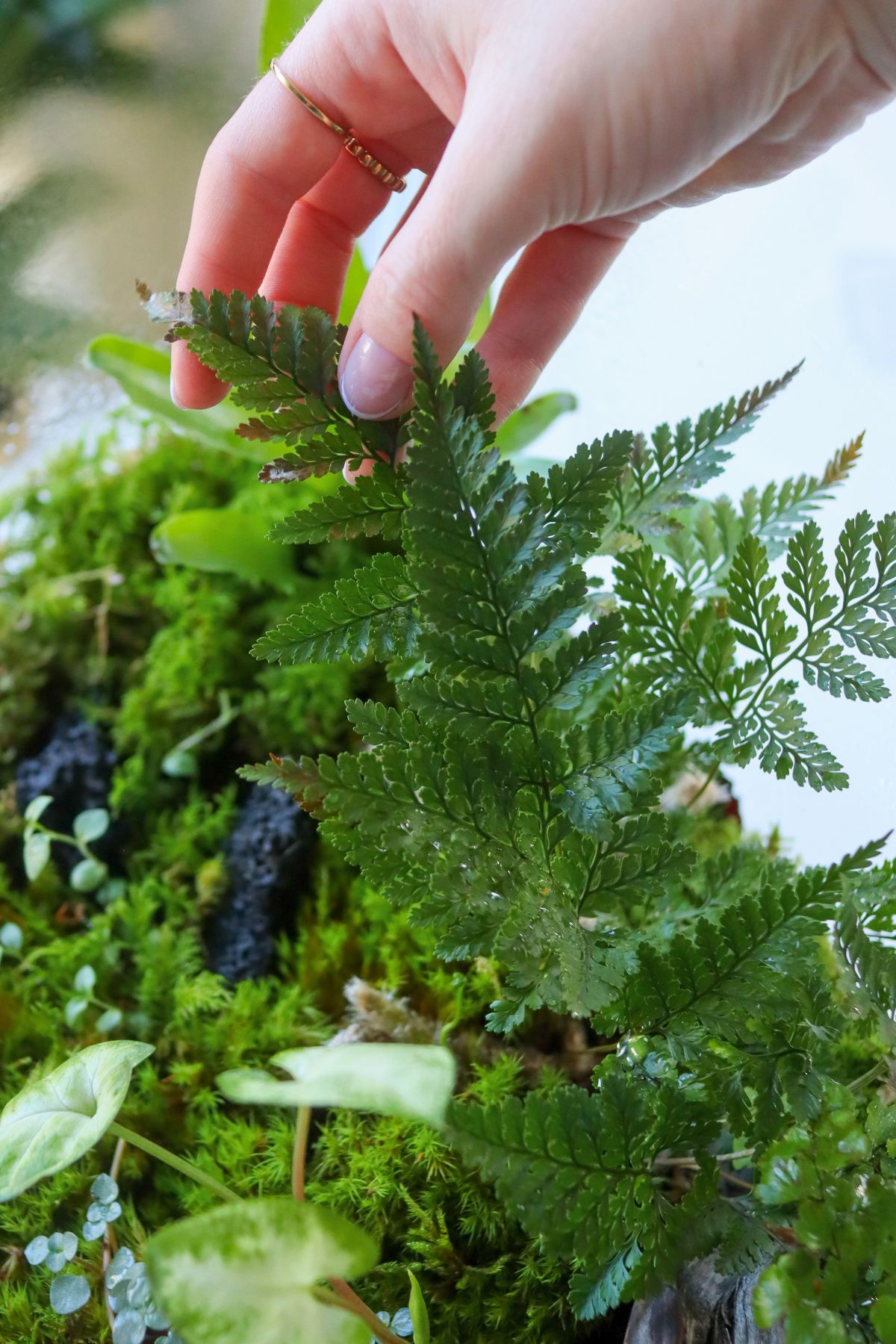
The Korean Rock Fern is a compact, textured fern with fine-toothed fronds and a surprisingly rugged personality.
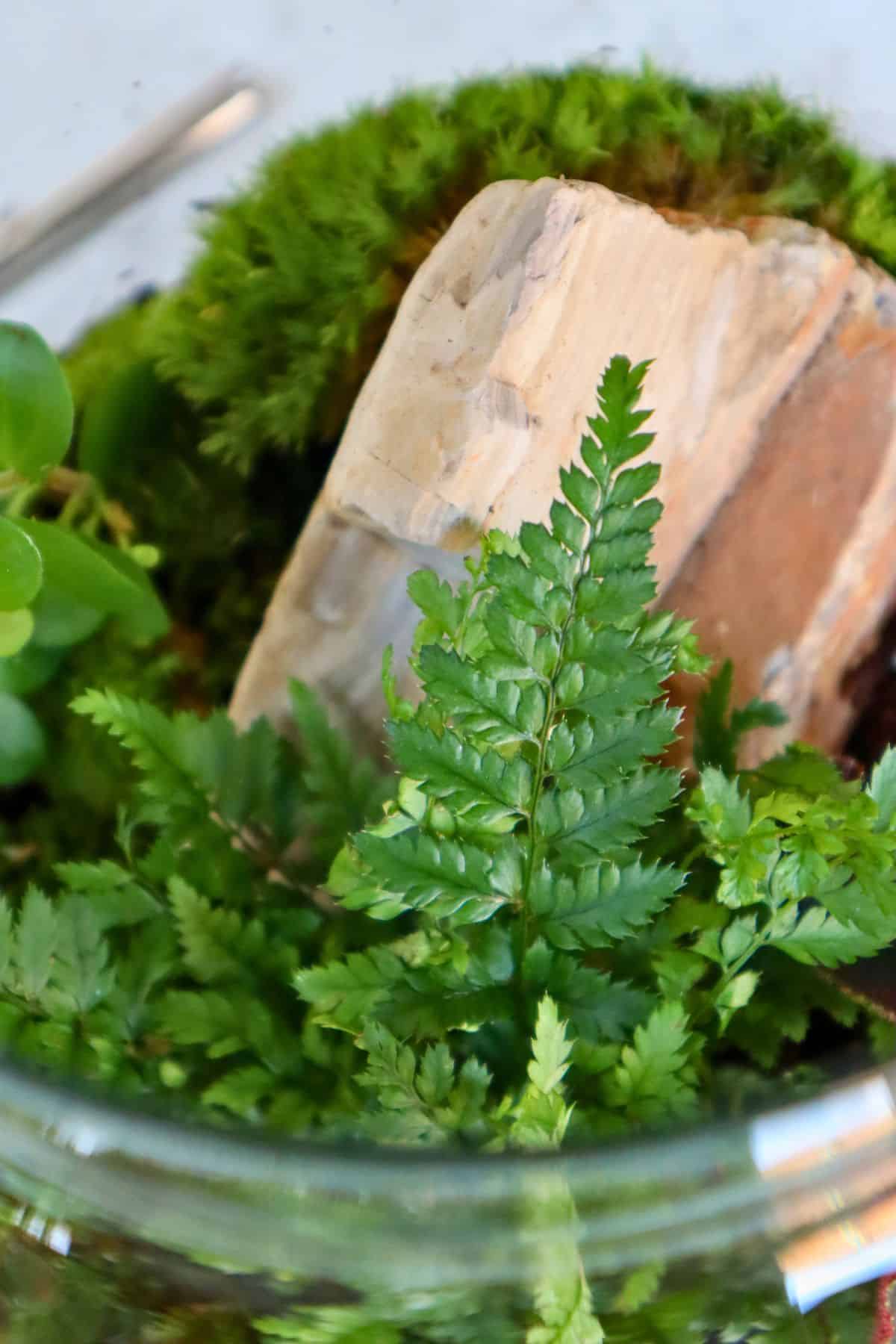
Polystichum tsus-simense is a little different from many of the tropical ferns people usually reach for. It’s temperate rather than tropical, but that isn’t a problem indoors. In fact, it makes the plant a little more forgiving.
It still appreciates humidity, but it’s not as sensitive as a Maidenhair Fern. It also handles normal indoor temperatures well and doesn’t demand constant tropical perfection.
In terrariums, its compact growth habit is the real win.
The fronds grow in a dense, structured pattern, giving you fern texture without the plant immediately trying to conquer the container. It’s also slow-growing, easy to trim, and straightforward to divide.
That makes it a particularly useful choice for people who want something ferny, reliable, and not too needy.
7. Kangaroo Fern
Verdict: A strange choice, suited to larger terrariums with room to spread.
The Kangaroo Fern, Microsorum diversifolium, has glossy green foliage with irregular, forked fronds that give it a wild, slightly unpredictable character.
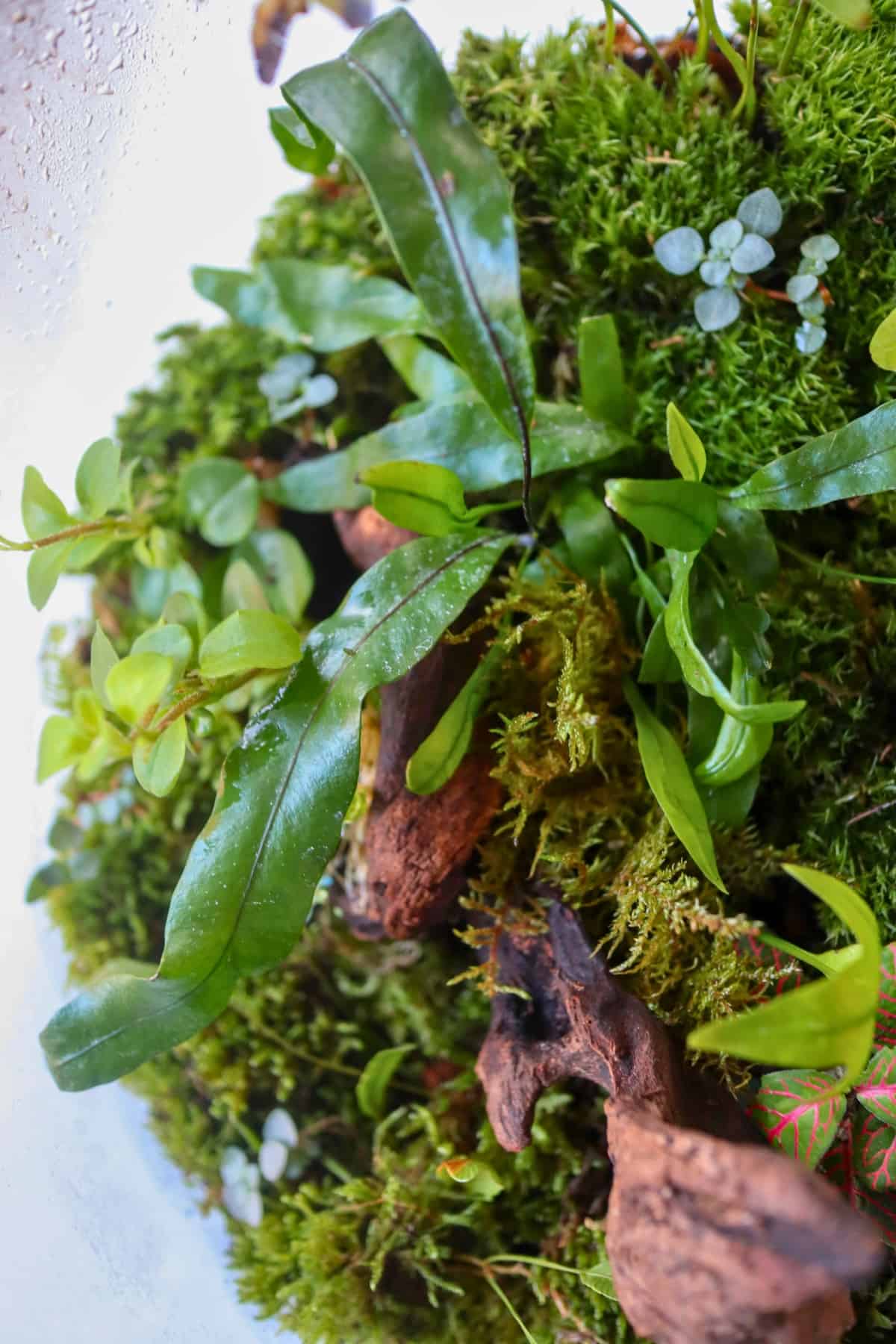
It’s another epiphytic fern by nature, but it doesn’t behave like a delicate little woodland tuft. It grows along a creeping rhizome and tends to spread horizontally, which can be brilliant in the right terrarium and awkward in the wrong one.
I’d use Kangaroo Fern in larger builds where that spreading habit has somewhere to go. It can add a lush, established look, especially when allowed to work around hardscape.
Still, give it good drainage. Like most epiphytic ferns, it wants a chunky substrate that holds some moisture but lets the roots breathe.
8. Silver Ribbon Fern
Verdict: A good terrarium fern for bright contrast and sharp texture.
Silver Ribbon Fern, Pteris cretica ‘Albolineata’, brings a different look to a terrarium.
Instead of soft, fluffy foliage, it has sharper fronds with a pale central stripe. That creamy variegation can brighten up darker green planting schemes and add a little structure without going full “statement plant.”
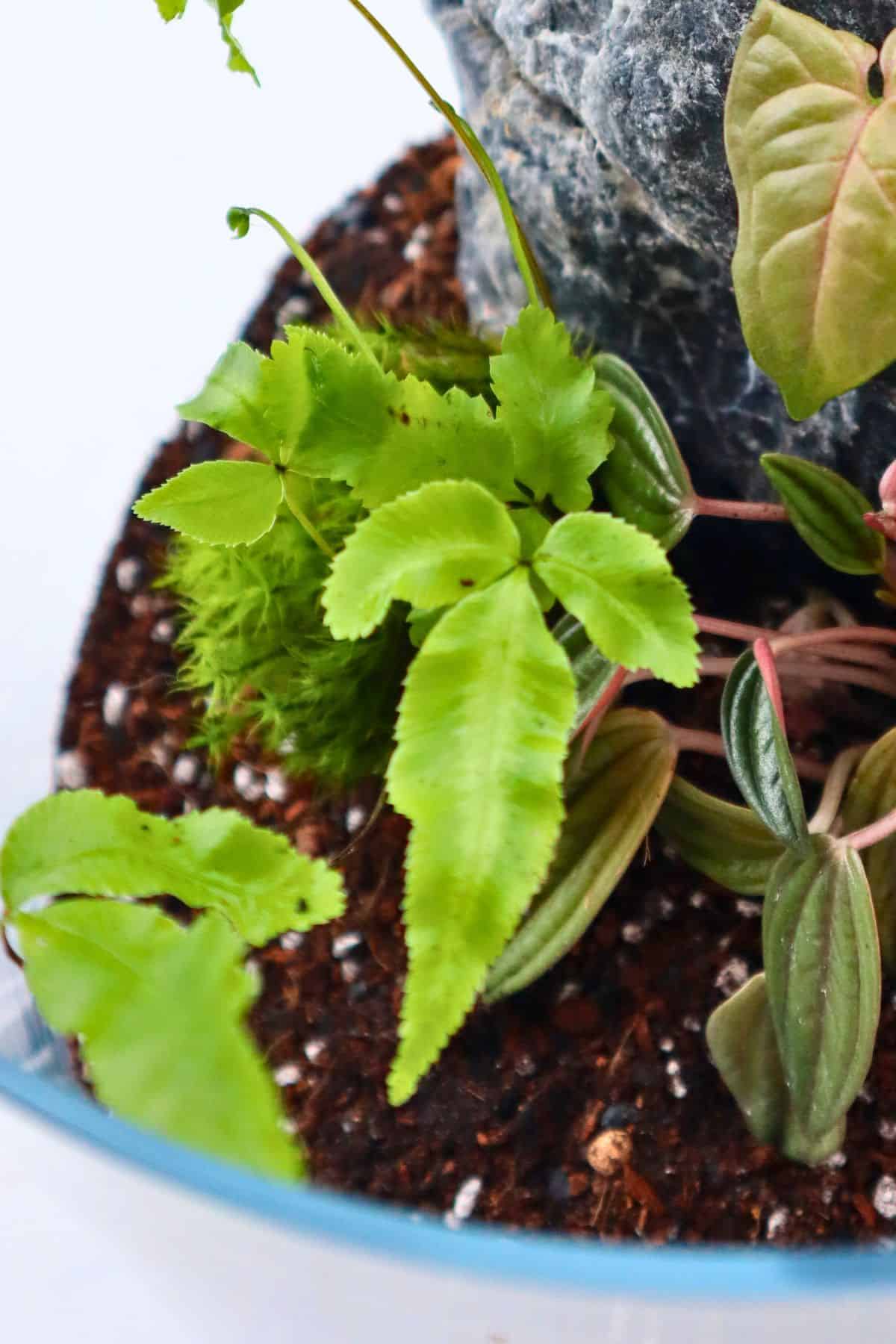
It’s a fairly hardy fern and makes an easy addition to terrarium environments, provided you keep up with moisture.
This is a typical fern in the sense that it wants consistent, even moisture and does not appreciate drying out. In a terrarium, pair it with other moisture-loving ferns and mosses rather than drier plants.
It can eventually reach around 20 inches, but it grows at a moderate pace and can be trimmed or divided if needed. That makes it fairly manageable for medium terrariums.
9. Crispy Wave Fern
Verdict: A strong terrarium candidate, but better in roomy containers (like a tank).
The Crispy Wave Fern is a cultivar of Asplenium nidus, often sold as a Bird’s Nest Fern type.
It has bright green, ribbon-shaped fronds with a ruffled, sculptural form. Not every fern has to be soft and feathery – Crispy Wave brings structure.
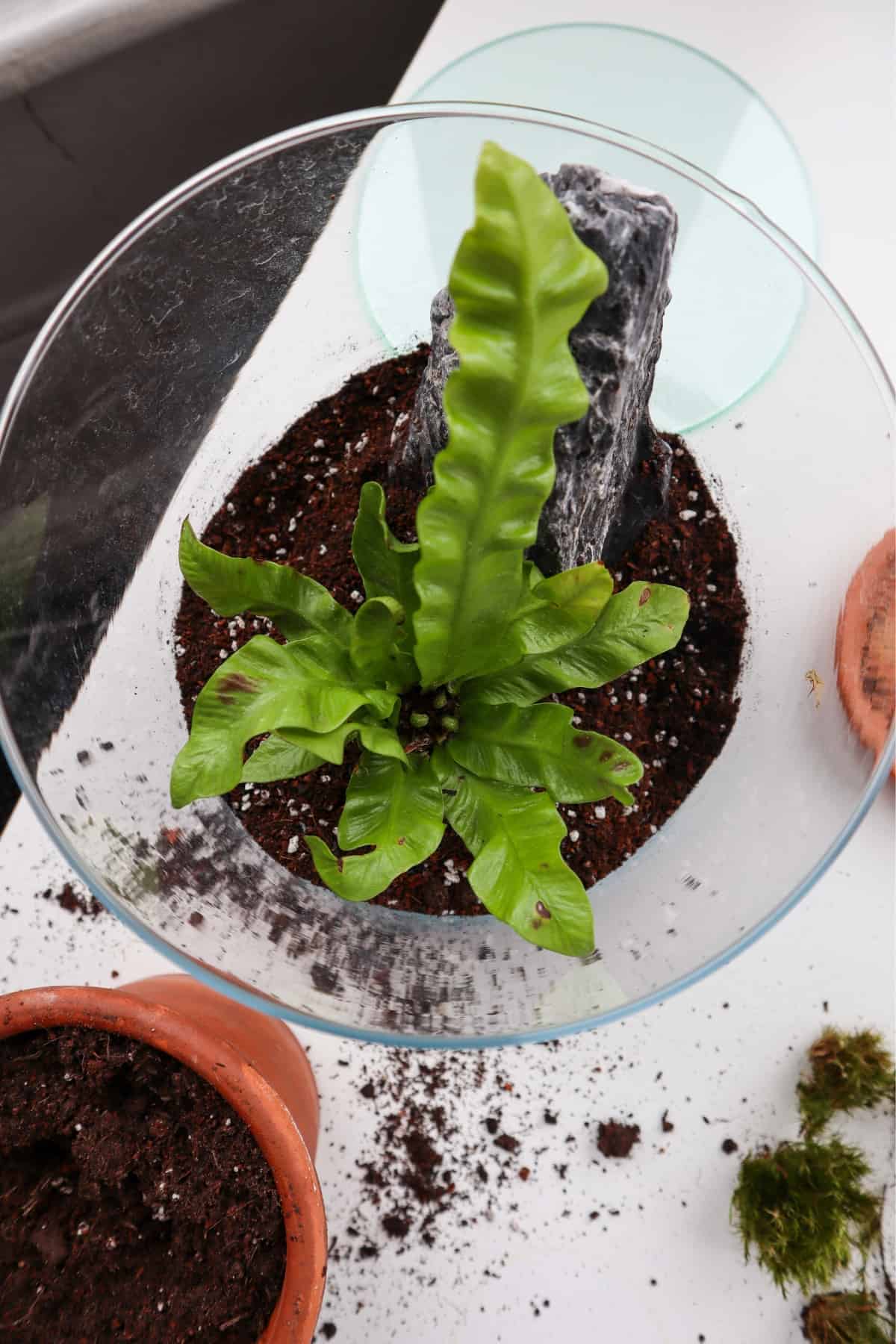
It is tropical, humidity-loving, and naturally epiphytic in the wild, where Asplenium species often grow in the forks of trees. That makes it a logical fit for terrariums and vivariums, especially larger builds with good moisture and stable humidity.
The main thing to understand is that Crispy Wave is not a tiny fern.
It may stay compact for a while when grown terrestrially, but given time and good conditions, it can produce much larger fronds. It works beautifully in tank-style terrariums, larger jars, and builds where you actually want an upright feature plant.
Watering also needs care. Crispy Wave likes even moisture, but because it has epiphytic tendencies, it needs good drainage and root aeration. In a closed terrarium, that means adding water gradually and avoiding a soggy substrate.
One specific warning – don’t pour water directly into the central “nest.” Stagnant water sitting in the crown is asking for trouble.
10. Silver Lace Fern
Verdict: A lovely terrarium fern with an odd vertical growth pattern.
Silver Lace Fern, Pteris ensiformis ‘Evergemiensis’, is one of the prettiest variegated ferns for terrariums.
Its slender fronds combine soft, feathery texture with a bright silvery center. It brings a lighter, more delicate look than Silver Ribbon Fern, and it works especially well when you want contrast without using a bold broad-leaf plant.
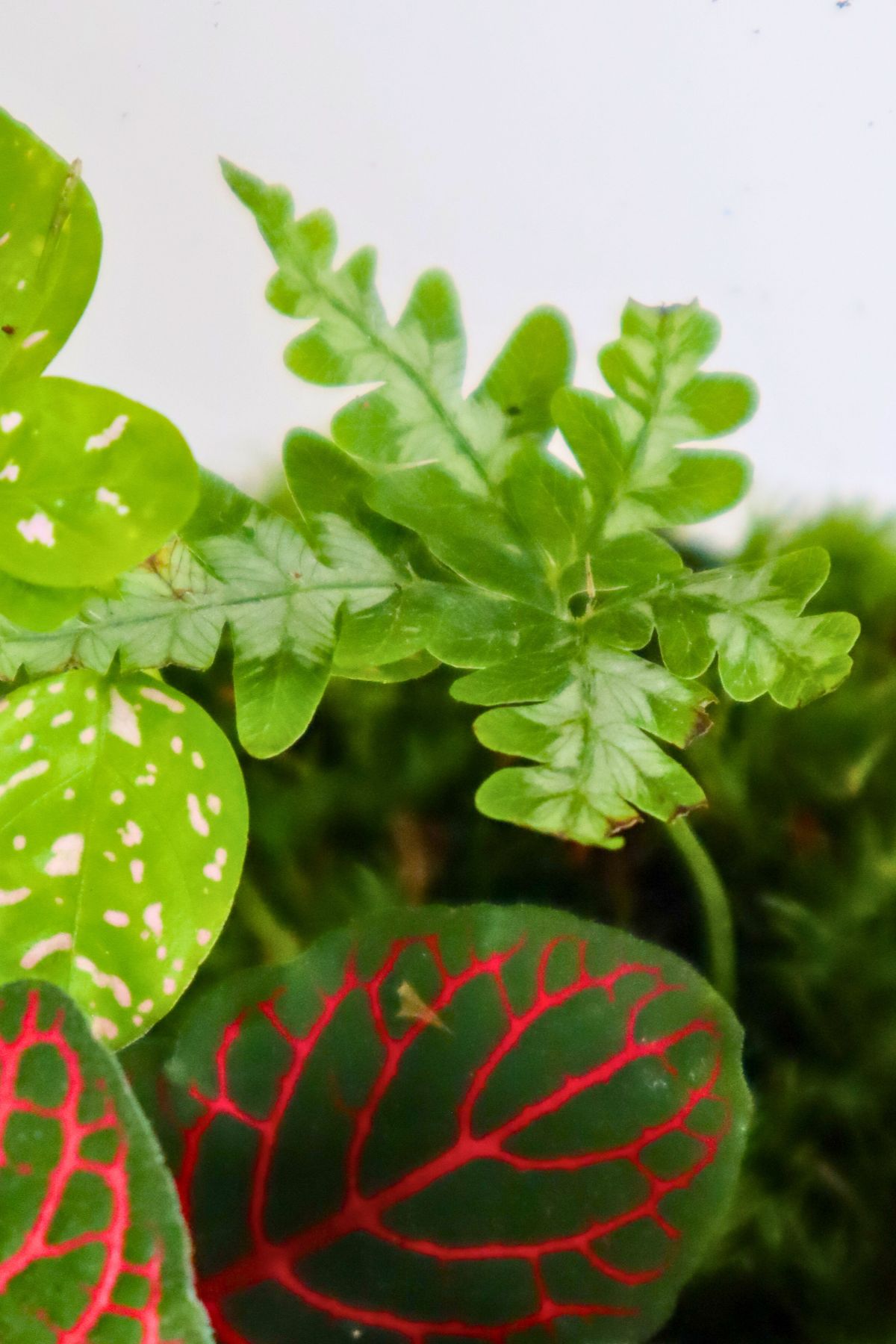
It’s tropical, humidity-loving, and naturally well-suited to a closed terrarium.
Growth is generally manageable in terrariums, though its upright habit means it may eventually reach the top of smaller containers. Fortunately, it divides easily, which is useful both for propagation and for creating smaller pieces for narrow terrarium openings.
11. Button Fern
Verdict: Delicate and cute, but a little harder to place.
Button Fern is a beautiful little plant with rounded leaves on arching fronds, giving it a softer, more polished look than many classic ferns.
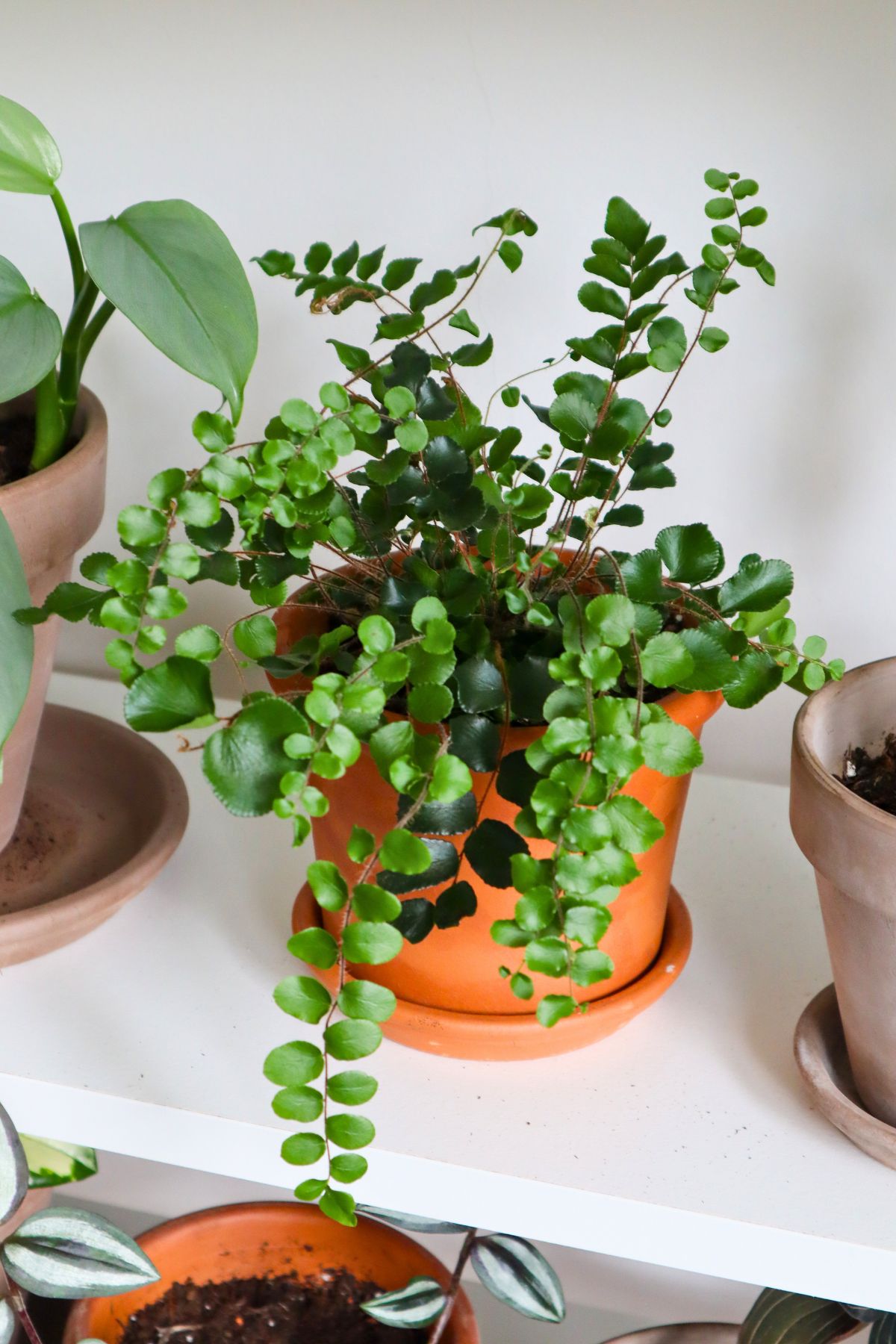
Pellaea rotundifolia usually tops out around 10–15 inches. That alone makes it a strong terrarium candidate.
The issue for me is that its leggy fronds and sprawling growth pattern make it really hard to find a good place for it. Despite its cute appearance, it ends up visually dominating a space.
Maybe I just haven’t figured out how to wrangle it yet?
Final Thoughts
These may not be terrarium-specialized ferns, but they are good options in the right setup.
As always, the best approach is to match the fern to the build.
For tiny containers, choose genuinely small or slow-growing species. For larger tropical setups, you can afford to be bolder with Blue Star, Crocodile, Kangaroo, or Rabbit’s Foot Fern.
And if you’re using these kinds of bigger ferns that can be divided easily (e.g., Nephrolepis), start with small divisions wherever possible.
