

There’s a lot to weigh up when deciding whether a plant really belongs in a terrarium.
You’ve got shape, spread, mature height, leaf size, growth rate, and whether the plant actually enjoys the kind of conditions a terrarium creates. What fits nicely today can be trying to eat the whole container six months from now…
Most people start with the obvious questions: Will it fit? Will it grow? Will it look good? But behind all of those is a bigger one – what even counts as a terrarium plant?
Plants come in all shapes and sizes, but the version you buy isn’t always the version you live with
In this guide, I’ll walk you through the traits that really matter, and the way I think about what makes a true terrarium plant.

What is a Terrarium Plant?
Most people define a terrarium plant as something small, slow-growing, and fond of humidity.
That’s a solid starting point, but it falls apart pretty quickly once you look a little closer.
What if you’re building a larger terrarium? What if you’re happy to prune regularly? And if most tropical plants will eventually need trimming anyway, how useful is “small and slow-growing” as a hard rule?
In reality, plant size is only part of the story. Some plants stay naturally compact. Some can be kept in shape with pruning. Some are a great fit for larger builds, but would quickly overwhelm a smaller one.
So the idea of the “right” terrarium plant is more flexible than it first appears.
A terrarium plant, then, is less about fitting a strict category and more about being suited to the system you’re trying to create.
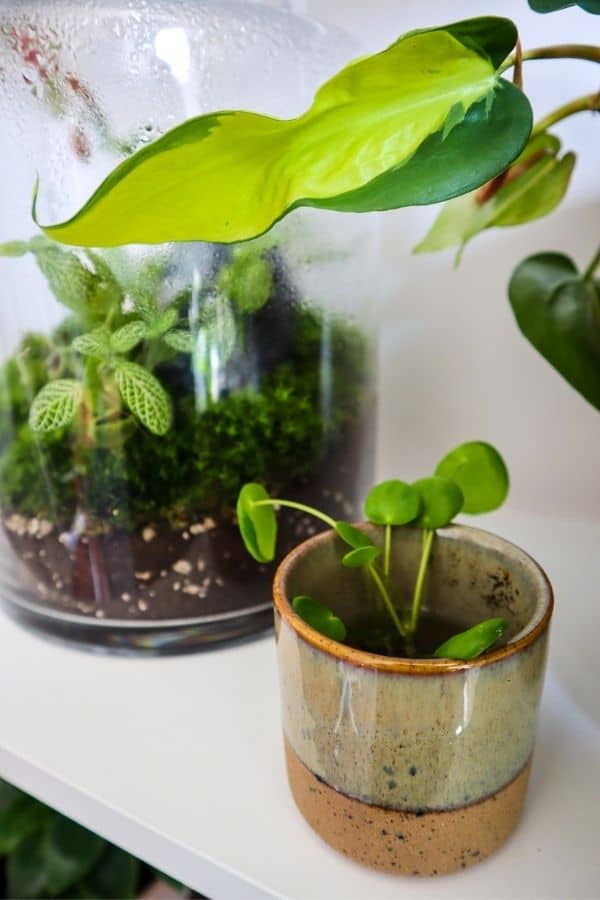
My Philosophy on Terrarium Plants
I prefer to empower people to make their own decisions on their plant projects.
As botanist James Wong says, “There are no mistakes in horticulture, only experiments.”
The truth is, most tropical plants will thrive in a closed terrarium.
It’s not about picking the “best” plants for terrariums but rather figuring out how to make any of them work.
*That being said, I know not everyone is here to test the boundaries of plant care, and some people want the easy choices. So, I do like to make it abundantly clear which ones are challenging (whether it be their size or care) and which are straightforward.
When it comes to what I consider terrarium plants, my only caveats are:
1. Plants with enormous leaf sizes.
Plants that can potentially grow bigger stems or vines can always be cut back (e.g., the different types of Pothos), but if the leaf itself is bigger than any reasonable terrarium, then there’s not much you can do about it.
For me, I think the max I’ll go to is the Anthurium clarinervium, as I have seen it in terrariums, but I appreciate it’s a real challenge to do so.
Something like a Monstera deliciosa is realistically never going to happen.
2. Succulents and Cacti
There are some semi-succulent plants that do surprisingly well in terrariums (e.g., Peperomia prostrata), but generally speaking, I don’t qualify succulents or cacti as terrarium plants.
Anything that doesn’t like humidity is not a terrarium plant in my books, and there’s not really a way around that in a classic terrarium (save for venting it for 99% of the day).
For a deep dive on terrarium plants and how to choose them, check out my full guide to plants for terrariums.
Judging Plant Sizes and Choosing Accordingly
What determines a plant’s “size”?
- The size of its leaves?
- The length or height of its stem?
- The likely maximum size or the potential max size under perfect conditions?
- The spread or density of the foliage?
Realistically, a single classification system can’t communicate all that variability.
However, I want the Terrarium Plant Index to be as helpful as possible – so I’ve created a loose system that can indicate the likely size range at maturity.
This includes the plant height/length (or arguably spread), whatever’s most relevant and largest.
- Small: 1-5 inches – Dwarf ferns, jewel orchids, mosses, bromeliads.
- Medium: 5-12 inches – Realistically, the maximum size of most tabletop terrariums.
- Large: 12 inches+ – Lots of big tropical ferns, vines, and some larger foliage plants.
Just bear in mind that this size metric can vary quite a bit, as plants grown under different conditions will grow… differently. That’s also why many plants are in two size classifications, as they can be easily kept small or allowed to grow.
Even large plants can be used in small terrariums if you’re happy to trim regularly!
Plus, when it comes to ferns, for example. I almost always divide them into much smaller plants (ideally with just one or two fronds each). So, just because a fern can get big doesn’t mean it can’t easily be used in a small terrarium with the right approach.
Using the Terrarium Plant Index
We’ve designed the Terrarium Plant Index to be as expansive as possible.
Offering a wide variety of plants for projects of all shapes, sizes, and biomes.
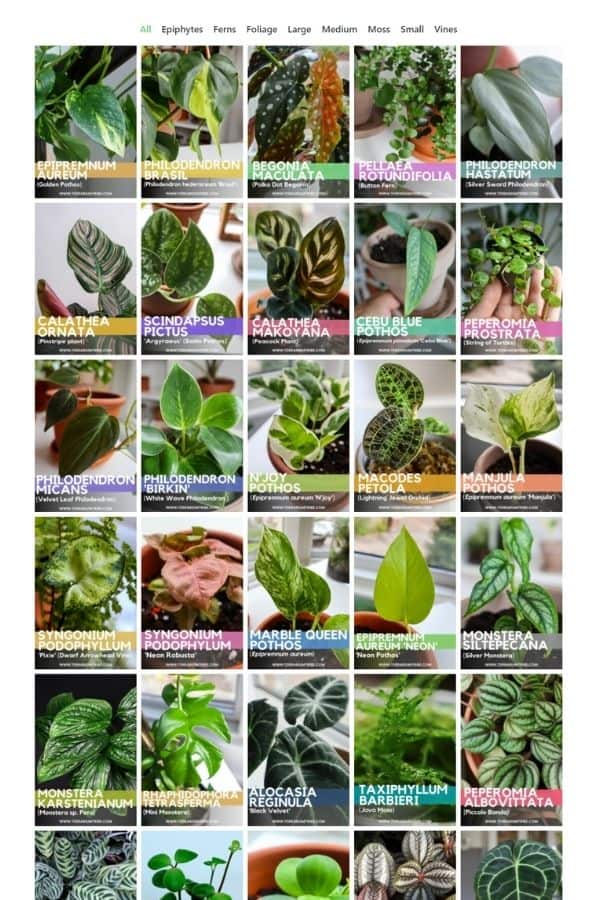
You can filter for small, medium, and large plants – along with their type, e.g., fern, foliage, epiphyte, or vine (currently, you can only apply one filter at a time, but we’re working on more).
In terms of the Plant Profiles themselves, they’re a complete overview to the plant – both in a terrarium and out. There’s so much crossover that we believe it’s better to provide maximum value.
We also strive to own and grow every plant.
Growing these plants in a pot, propagating them, and then growing the new plants in a terrarium is the ideal flow for us. That way, we can speak to every step of the process.
Whilst that’s not always possible (we live in a two-bedroom apartment, and some plants are really expensive, you know), we will do as much research and collaborations as necessary to get the content right.
Over to You
How do you define a “terrarium plant”? I’d genuinely love to hear your thoughts.
Or better still, what is a terrarium to you? That seems to get more complicated by the day.
