

When it comes to terrariums, the phrase “bigger is better” rings true in many ways.
After all, a large terrarium has more space, more options, and ultimately more plants (hurrah). But it can also come with more challenges.
Depending on your needs, the type of large terrarium container you choose can make or break your project. So strap in, as we’re covering everything from colossal carboys to giant tanks, so you know exactly what to look out for.
Go big or go home! Let’s do it.

Types of Large Terrariums for Plants
Planted large terrariums are just as diverse as small ones, but they tend to follow three distinct types when it comes to containers.
After all, there’s only so much out there that can accommodate a planted ecosystem at scale.
It’s not like there are many oversized mason jars or giant whisky bottles out there, right? (If only…)
You’re generally either adapting what’s already out there or you’re going the custom route. Which you choose depends on your planting goals and your appetite for challenge.
So, here’s how this might play out.
Bottles
Honestly, you can get some giant bottles if you know where to look.
The kind traditionally used to brew beer and wine (e.g., the carboy or demijohn) can be over 50 liters in volume! They are also somewhat of a terrarium classic.
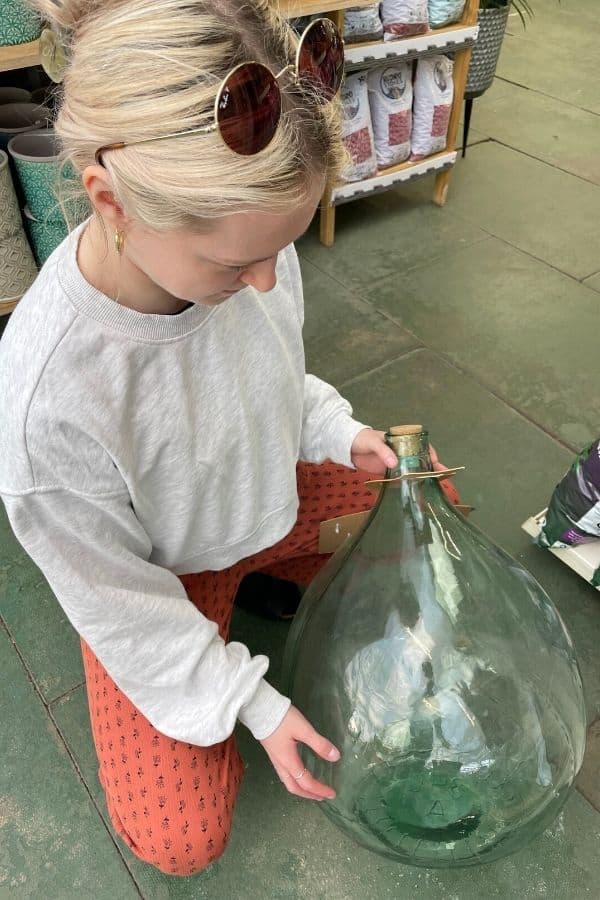
You could call these the ultimate bottle garden containers.
They’re a stunning way to house tropical terrarium plants, but as you might imagine, with a bottle, you’re still somewhat restricted by space… and skill. Planting through a narrow opening is one thing, but you’re on to a whole new level of difficulty when your tools don’t reach the bottom.
Definitely one for more advanced terrarium builders.
Tanks
I’m sure we’re all familiar with the classic horizontal tank, but there’s also the vertical cabinet style.
Between these two modern closed terrarium approaches, you have something that can accommodate almost any kind of tropical plant.
Each can be done DIY style by adapting the likes of an Ikea glass cabinet or an old fish tank.
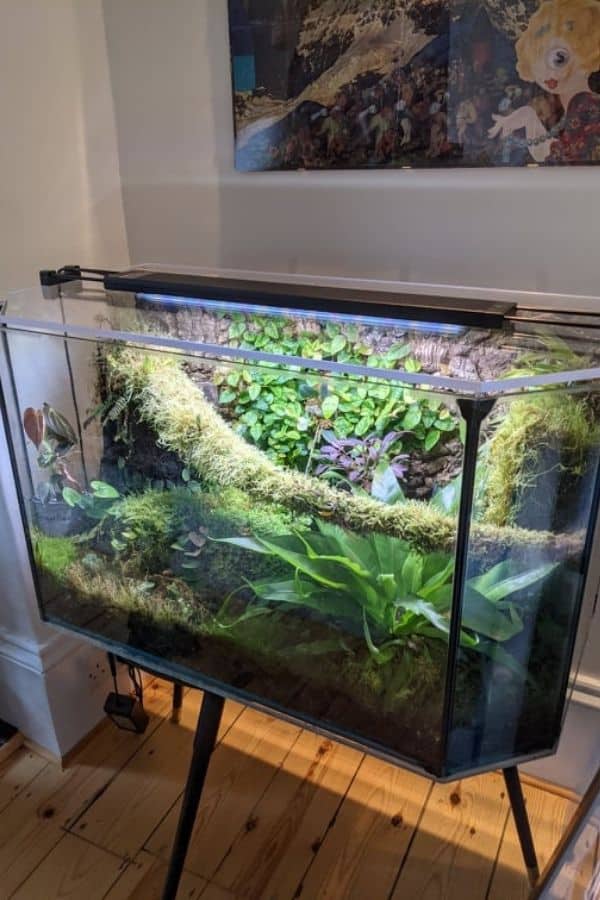
Alternatively, many well-known reptile terrarium companies stock these kinds of large tank terrariums.
The size makes them versatile and adaptable, each capable of accommodating modern technical systems.
Lighting, ventilation, waterfalls… these tanks can do it all. Plus, it makes it so much easier to be a little more ambitious in your landscape when you can actually get inside!
It’s common to see these large terrariums transformed with elaborate custom backgrounds and hardscape arrangements.
The clean slate that a tank offers is an attractive proposition for those with an uncompromising vision. There are limits to what you can do in a bottle, trust me.
Finally, these tanks really shine as practical planters and reptile enclosures, too (where you’re not fighting the container to get the best from it).
Wardian Cases
Back on the topic of classics, the Wardian Case was the very first incarnation of the modern terrarium.
Used to transport tropical plants around the world back in the Victorian era, it’s no surprise that they can be scaled to become quite large terrariums. Who knows what kind of monstrous plants needed to be moved to wealthy aristocrats and botanical gardens?
Much like a miniature greenhouse, these elegant containers are ideal for enclosed tropical builds – especially if you’re aiming for a true self-contained terrarium environment.
Of course, they are still just a basic glass containers, so there are limits to what you can customize or add. But as far as large glass-planted terrariums go, Wardian Cases are an amazing choice.
Great for taller plants that need some real headroom to thrive.
Scale Changes the Rules
When you scale up, the container isn’t just holding the ecosystem – it actively shapes how that ecosystem behaves.
Humidity can be harder to build and maintain at larger volumes. More plants means more watering, which also requires more drainage. And big plants and small openings don’t really work…
At this size, you have to more closely consider the foundational aspects of a terrarium.
You can’t simply scale up a small-jar method and expect the same results – going big only works when the structure makes sense.
But when it works, it really works.

Thank you Dan for sharing your vast knowledge. I am a Set Decorator for the Studios, so every gift I give is personilized . I grew up in the 1960s when Hippies made popular bringing nature indoors using live house plants and Terrariums.
These environments in a jar are still inspirational.
bmb