

Prayer plants are awkward terrarium candidates.
They love the humidity, warmth, and steady moisture of a closed system, but they’re less thrilled about being sealed behind glass with wet leaves and limited airflow.
Still, they’re not off the table.
Used carefully, the right prayer plant can bring bold foliage and natural movement to a larger terrarium. The trick is choosing manageable varieties, giving them breathing room, and keeping moisture around the roots rather than all over the leaves.
This guide breaks down the best prayer plants for terrariums and where they work best.
The Terrarium Trade-Off With Prayer Plants
Prayer plants can be solid terrarium plants, especially in warm, humid tropical setups.
The main reason is simple. Terrariums solve the humidity problem.
Prayer plants often struggle as houseplants because normal indoor air is too dry and inconsistent. Behind glass, these plants get to enjoy high humidity 24/7. That gives plants like Calathea, Ctenanthe, Maranta, and Goeppertia the kind of conditions they’re usually asking for.
That’s what makes them so tempting for terrariums.
They bring bold, patterned foliage, rich color, and that subtle daily leaf movement that makes a planted setup feel more alive. Used well, they can turn a tropical terrarium from “nice collection of plants” into something much more layered and intentional.
But there is a trade-off.
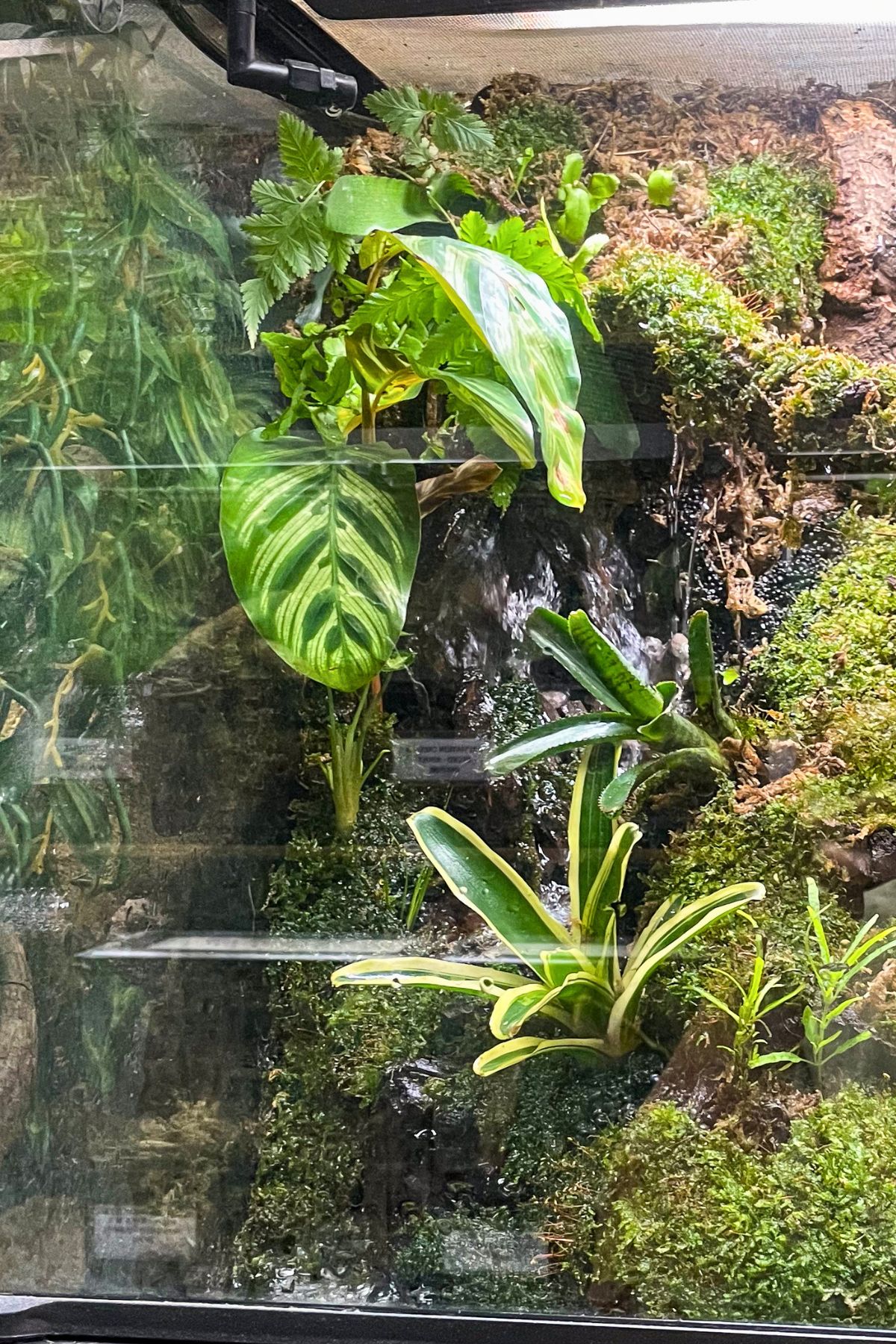
Prayer plants like moist, humid air, but they don’t want to be sealed into stale, wet conditions forever. They’re particularly sensitive to poor airflow and to having their leaves stay wet (which can happen easily in glass containers after misting).
That’s the awkward balance.
Preserving humidity usually means reducing airflow, and there’s no perfect solution to that in a fully closed terrarium. It doesn’t mean you can’t use prayer plants behind glass, but they do need more care and judgment than hardier terrarium plants.
Think humid and breathable, not wet and sealed.
Choosing Prayer Plants for Terrariums
Not all common prayer plants make equal terrarium candidates.
Some stay more compact and manageable than others, but in truth, most are going to get pretty big eventually. These options are all best for larger terrariums, or used as short-to-medium-term candidates (starting with small divisions helps buy you time and space).
A few are more forgiving, while others are mostly there to test your emotional regulation.
Here are the main types you might come across, and whether they work in terrariums.
Calathea makoyana (Peacock Plant)
Calathea makoyana is probably the classic prayer plant showpiece for terrariums.
The leaves are beautifully patterned, with pale green markings, darker edges, and purple undersides. It has that unmistakable Calathea drama, but it can still stay reasonably manageable when young.
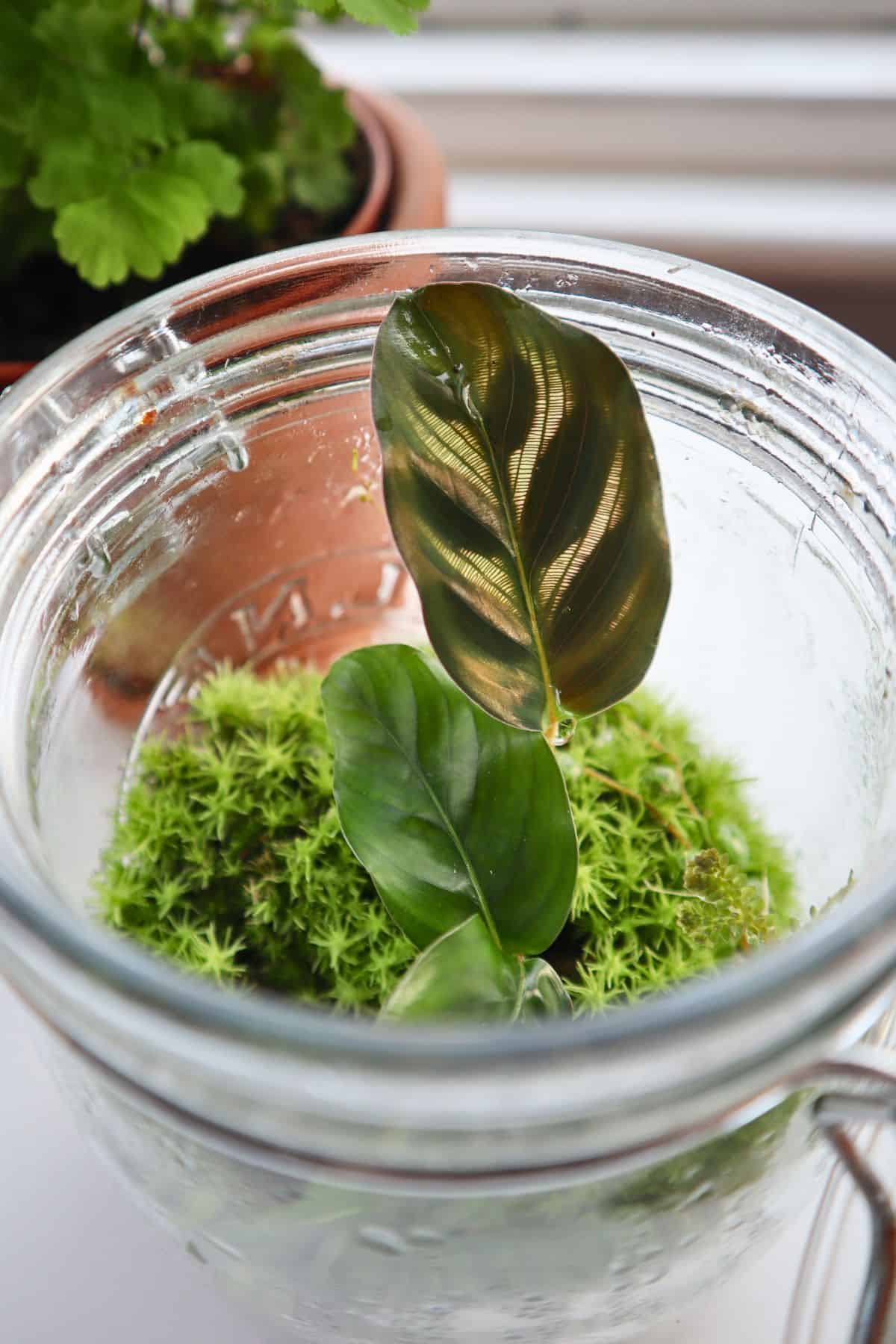
That makes it a strong choice for medium and larger terrariums where you want a proper foliage focal point.
In a terrarium, I’d try to position Calathea makoyana somewhere it has room to open and move its leaves without being pressed against the glass.
Calathea musaica (Network Plant)
Calathea musaica is one of the more practical prayer plants for terrariums.
It has intricate mosaic-patterned leaves rather than big, loud markings, so it brings detail without overwhelming the build. It also tends to be a little easier-going than many classic Calathea (which is always welcome).
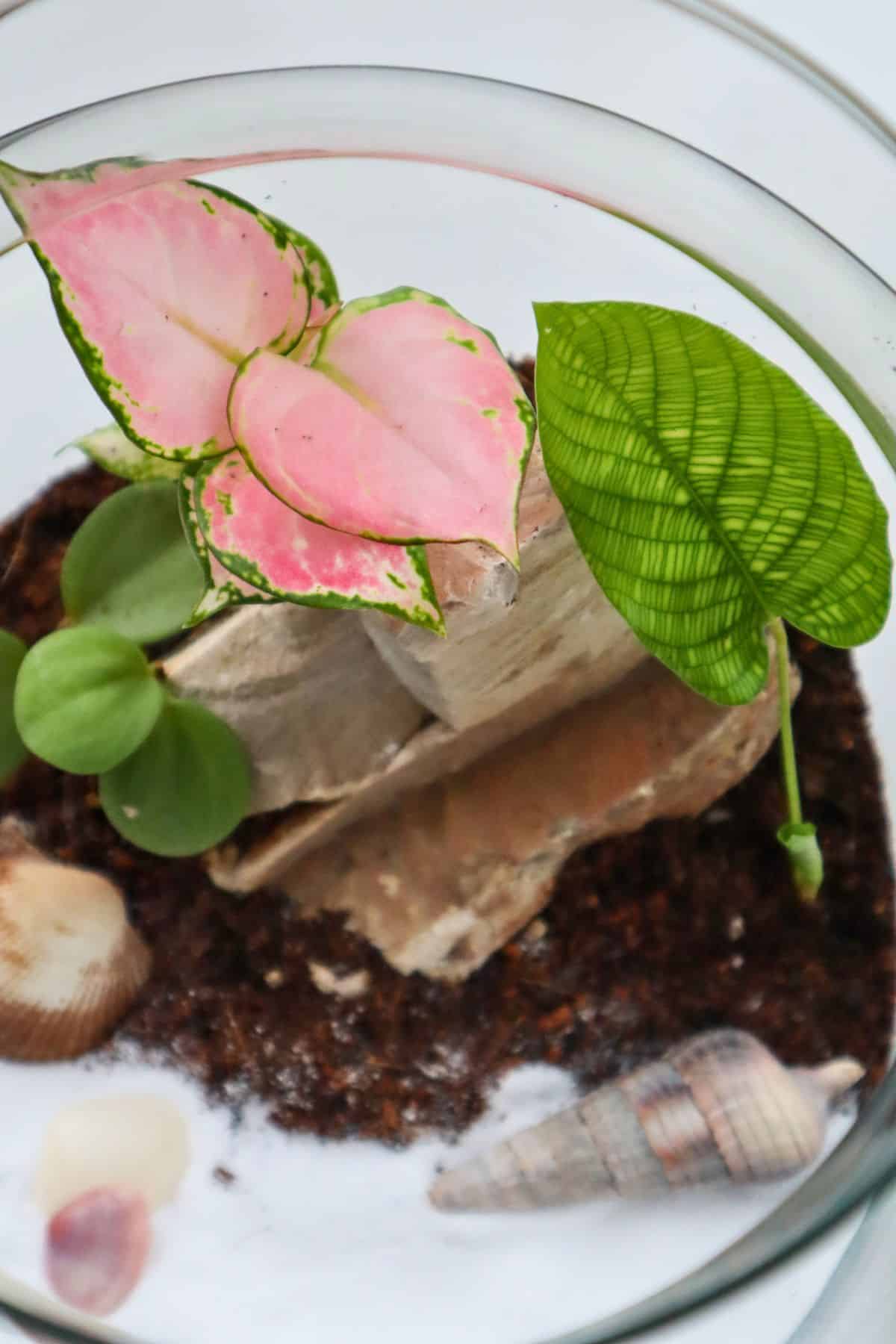
Technically, this plant is now more accurately classified as Goeppertia kegeljanii.
Thankfully, “Network Plant” is much easier to say, spell, and emotionally process.
For terrariums, the size is the real advantage. Calathea musaica usually stays fairly compact (by Calathea standards, at least). Maxing out around a foot tall, making it much easier to use than the larger, broader-leaved types.
It’s a good fit for medium tropical terrariums where you want a detailed foliage feature rather than a huge statement plant.
Ctenanthe burle-marxii (Fishbone Prayer Plant)
Ctenanthe burle-marxii is one of the better prayer plants for terrariums.
It has the classic prayer plant look – patterned leaves, purple undersides, and responsive foliage – but it tends to be a little more forgiving than many Calathea.
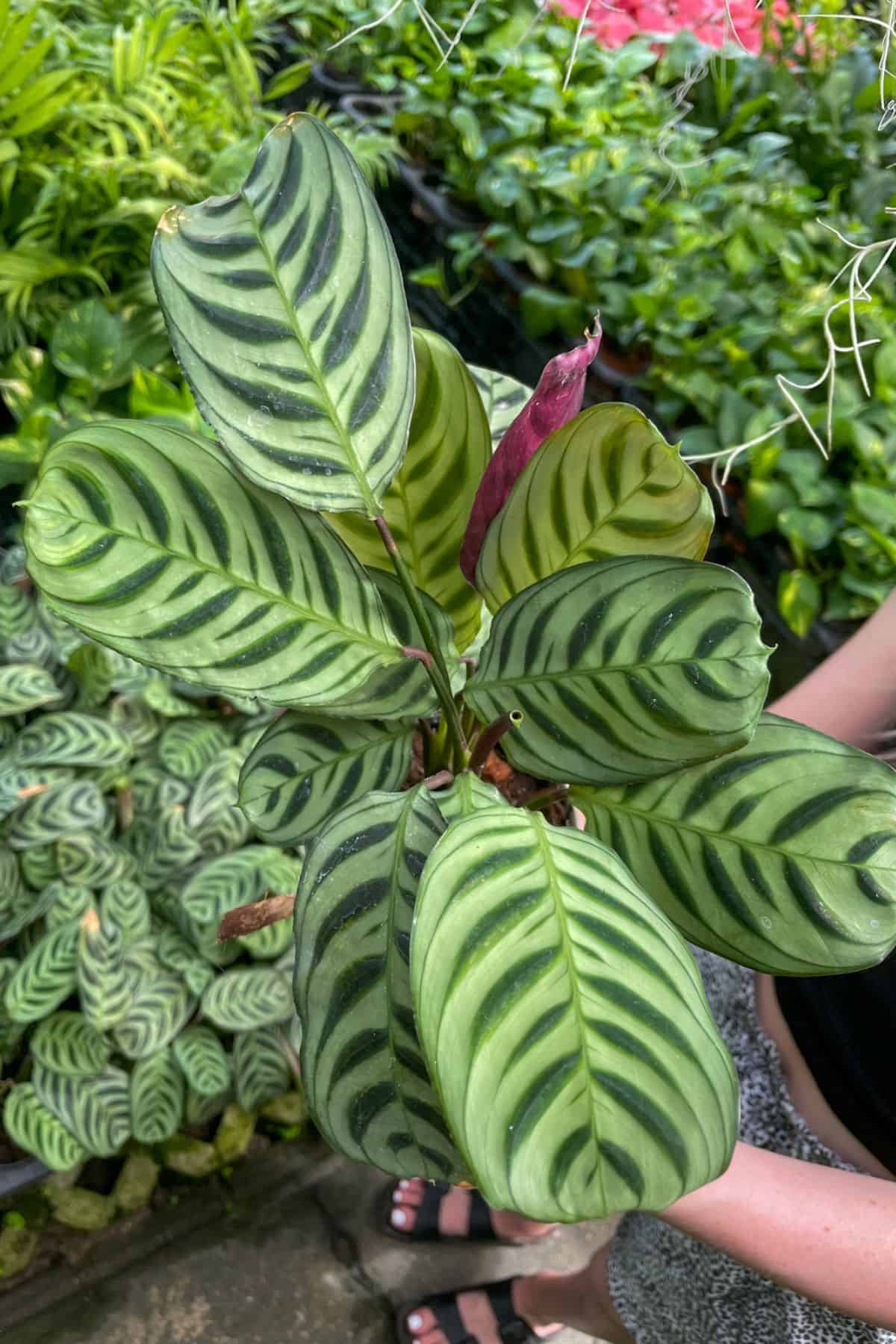
That makes it a good entry point if you want the prayer plant effect without immediately signing up for botanical drama.
The other big advantage is its growth habit.
Fishbone Prayer Plant tends to stay compact and bush-like, which makes it much easier to place in a terrarium than larger, broader-leaved species. It can still outgrow a tiny container eventually, but it’s a much more realistic option for medium tropical builds.
It does have more of an upright growth pattern, though, so your container height matters more than its breadth here.
Calathea orbifolia (Goeppertia orbifolia)
Calathea orbifolia is beautiful, but it’s not the most practical prayer plant for most terrariums.
The leaves are broad, round, and silvery-green, and given enough time, they can become huge. That’s what makes the plant so impressive – and exactly why it can be awkward behind glass.
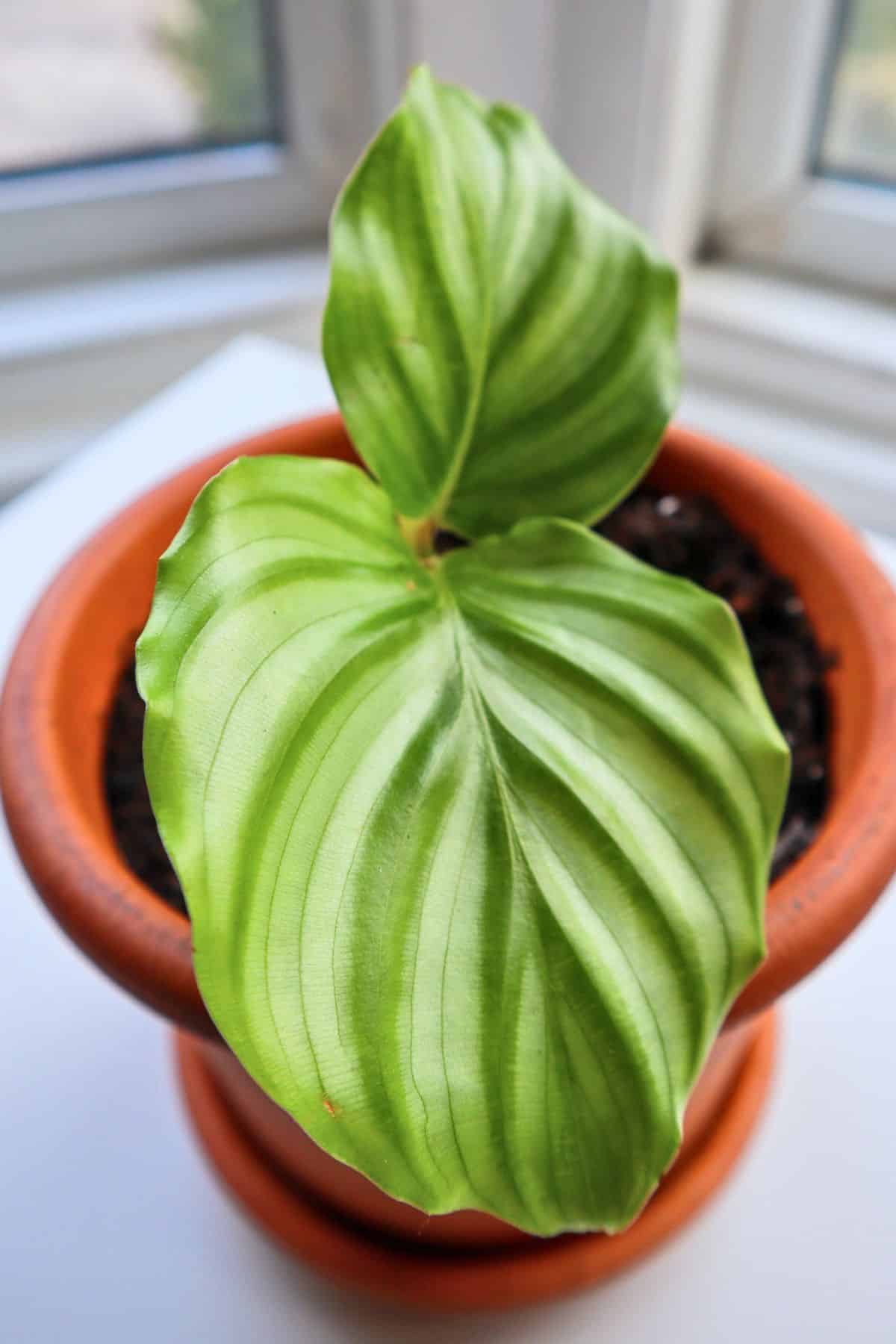
In a large terrarium, orbifolia can be spectacular, but the scale is an issue.
Even if the plant technically fits, the leaves need room to spread naturally. If they’re pressed against the glass, crowded by hardscape, or constantly touching wet surfaces, the whole thing starts to feel forced.
This is a plant for large glass displays, not cute little jars.
That said, Calathea orbifolia is not necessarily a rapid grower. In softer light, it may stay smaller for longer. But I wouldn’t rely on slow growth as the main design strategy.
Calathea ornata (Pinstripe Plant)
Calathea ornata is stunning, but realistically, it’s too big for most terrariums.
Dark green leaves, pink pinstripes, purple undersides – it has absolutely no interest in being subtle. But it also grows upright, broad, and eventually large enough that most glass containers won’t give it the space it needs.
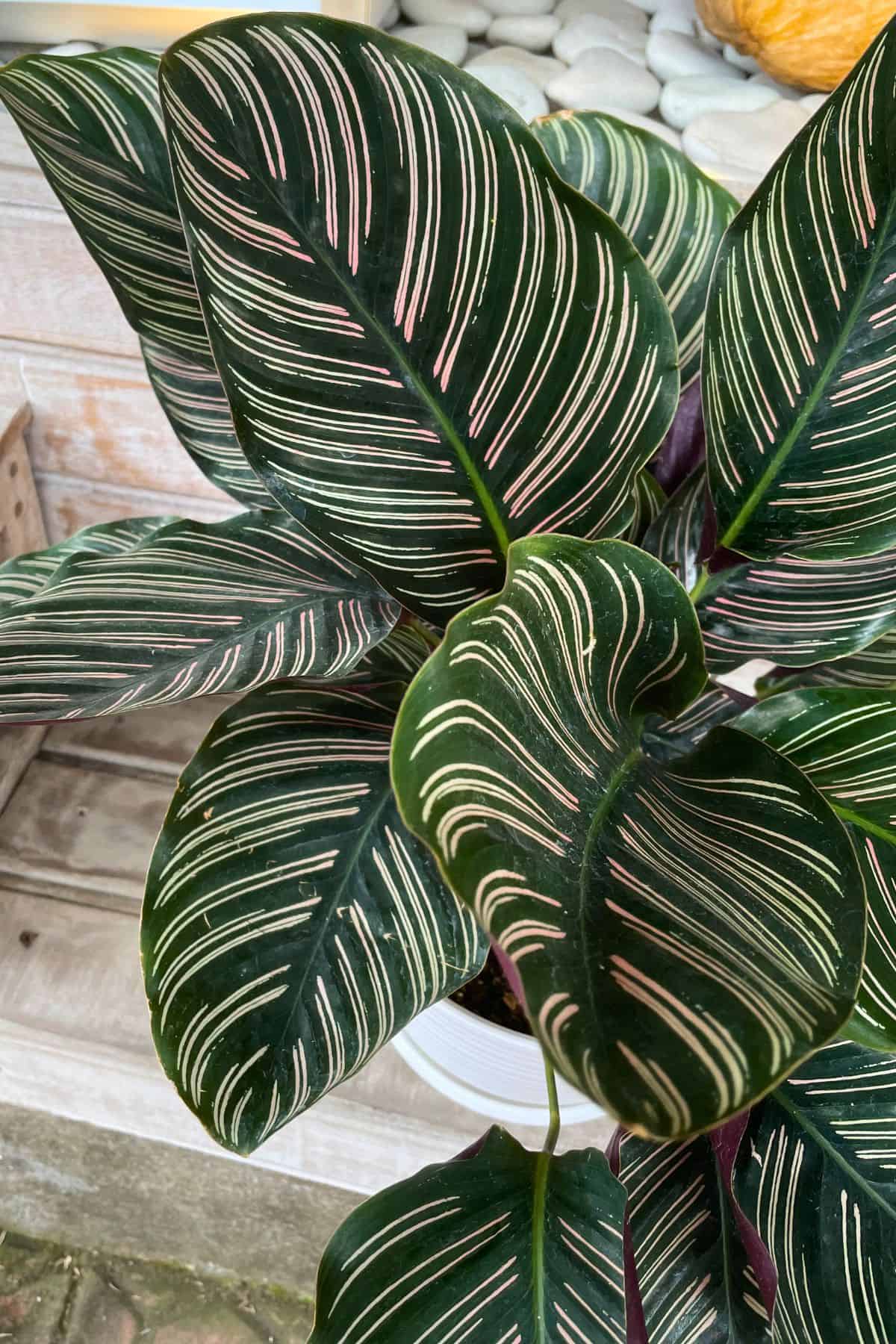
That doesn’t mean it can never work.
A young Pinstripe Plant could be used temporarily in a larger tropical terrarium or glass cabinet-style display, especially if you want a bold focal plant for a while. But as a long-term terrarium choice, it’s usually more plant than the container can sensibly handle.
Even before it reaches full maturity, those broad upright leaves need room to open properly.
Calathea ornata really is beautiful. It’s just usually better as a houseplant than a terrarium plant.
Final Verdict
Prayer plants bring bold pattern, movement, structure, and color contrast that few other terrarium plants can match.
But they only work when the setup matches what they actually need.
They’re simply not the best choice for tiny sealed jars or low-maintenance builds you never plan to check.
For most terrariums, I’d start with Ctenanthe burle-marxii, Calathea musaica, or Calathea makoyana. They give you the prayer plant look while staying more realistic for glass setups.
I’d absolutely recommend dividing them to get the smallest possible plant. That’ll at least give you some breathing room.
Get the balance right, and prayer plants can be some of the most striking foliage plants you’ll ever grow behind glass.
Dramatic? Absolutely. Worth it? Also yes.
